
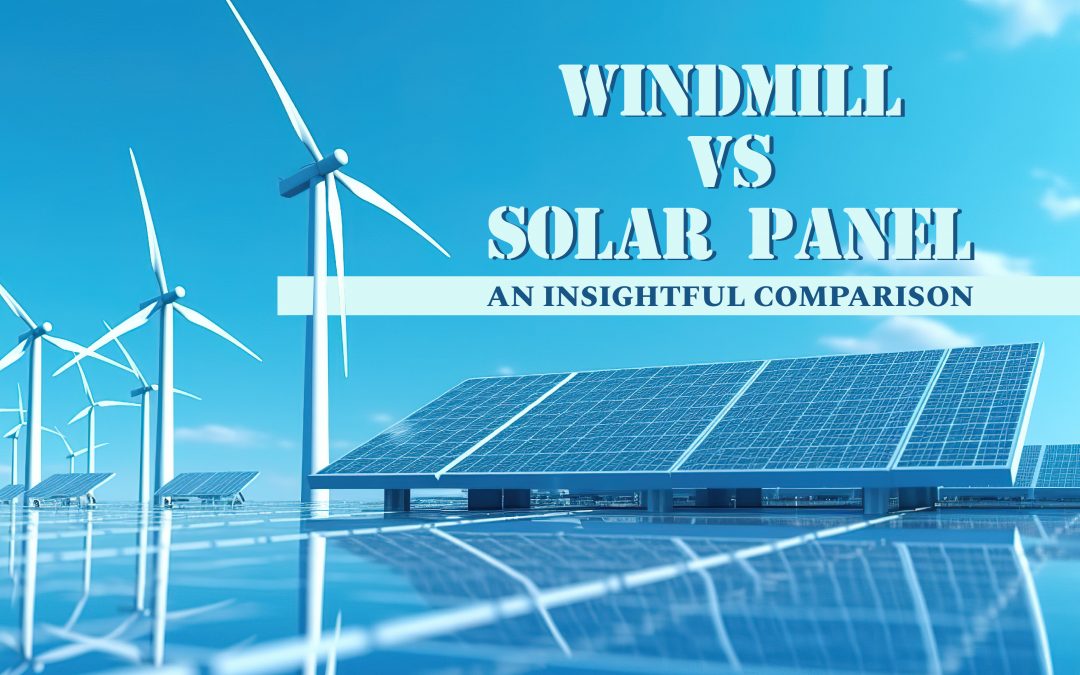
When we think of renewable energy, we typically have a couple of ideas in mind, solar panels and wind turbines! They are clean, green alternatives to fossil fuels on the practical side of viable energy sources, but they are not the same. They both have pros and cons and which is “better” ultimately comes down to your own particulars like where your living location is, how much you are willing to pay and what your energy needs are.
Ever wondered whether rooftop solar panels outperform a small garden wind turbine or which is better for countries like India?
You’re in the right place to find out. We are going to look at the subject for sure but also in a bit of a streamlined and straightforward way.
What is a Windmill and Solar Panel?
Windmill(Turbine): New windmills or wind turbines work by capturing flowing air energy with sails (blades). When the blades of the generator rotates, it converts the mechanical energy into electricity. Windmills are typically designed to be constructed in open grounds or ocean where wind is abundant and consistent.
Solar Panels: These thin flat panels have photovoltaic(PV) cells that absorb sunlight and convert it into transition energy. Solar panels can be mounted on buildings roofs, installed on parking lot edges, or installed in empty areas. This is great because they can be mounted in so many ways.
How do they function?
Windmills: Wind blows against turbine blades causing movement, the blades in motion drive a generator that produces electricity. The more consistent and stronger the wind the more electricity generated.
Solar Panels: The sun strikes a PV cell and the light excites the electrons which creates electricity. The electricity is then changed into a current that we can use for our homes and buildings.
The Cost Factor
Installation
- Solar Panels: With prices declining and government subsidies, solar panels now range from $2,500–$3,500 per kilowatt (kW). For many families, this is an acceptable starting point for renewable energy.
- Wind Turbines: A domestic wind turbine that is small in size could cost you $3,000–$8,000 per kW occasionally more. More sizable turbines, such as those used in wind farms can cost millions.
Maintenance
- Solar Panels: Once installed, they’re low maintenance. Other than routine cleaning and the occasional replacement of an inverter, there’s not much to do.
- Wind Turbines: Having moving parts, turbines need regular tune-ups, oil changes and frequent expensive repairs.
Return on Investment
- Solar Panels: Typically pay for themselves in 6–8 years and they have a life expectancy of 25–30 years.
- Wind Turbines: Also financially rewarding, but only for extremely windy sites. In less auspicious sites, the payback period plods along much later.
Efficiency and Power Output
- Solar Panels: Contemporary panels are usually around 17–23% efficient and high-quality ones even more so. They produce maximum power in sunny locations but still generate some electricity even on cloudy days.
- Wind Turbines: Efficiency of 35–45%, which is great, but only if the wind is with you. No wind? No power.
In brief:
- Solar panels do wonderful on rooftops and in urban areas.
- Wind turbines are more appropriate for rural, coastal areas or off-shore regions.
Environmental Considerations
- Solar Panels: They don’t emit harmful gas while in use but disposal is where the problem lies. Once their life span of around 25 to 30 years conclude, the panels that have been utilized would need to be recycled and this is an area where agencies such as the U.S. EPA is trying to address issues.
- Wind Turbines: They don’t generate emissions into the air all the while they can be noisy and can sometimes present risks to wildlife (especially birds and bats). Offshore wind reduces those risks.
Wind vs Solar: Pros and Cons in a Nutshell
| Attribute | Windmills(Turbines) | Solar Panels |
| Efficiency | 35–45% in windy areas 17–23% | 17–23% |
| Cost | Higher initial cost + more expensive to maintain | Lower initial cost + low maintenance |
| Ideal for | Rural, coastal, offshore sites | Urban, suburban and sun-oriented areas |
| Life Expectancy | 20–25 years | 25–30 years |
| Drawbacks | Noise, wildlife threats | End-of-life recycling problems |
The Case of India
India provides an interesting illustration of how both energy sources are utilized.
Solar Power:
- With so much sunshine throughout the year, solar energy is booming.
- Schemes such as the PM-Surya Ghar Muft Bijli Yojana are making residents shift to roofs and reduce electricity bills.
Wind Power:
- In India, wind is concentrated in Tamil Nadu, Gujarat and Maharashtra.
- Wind farms with large installed capacity primarily contribute to the national grid but there is limited use of small wind turbines in individual residences.
Which Works Better at Home?
For most homes:
- Solar Panels win hands down. They’re cheap, convenient to install and backed by government incentives.
- Wind Turbines are helpful if you reside in a highly windy rural location, but zoning restrictions and noise tend to make them not practical for subdivisions.
Why Wind Could Occasionally Top Solar
- Turbines are able to operate day and night, as opposed to solar which requires sunlight.
- They produce more power per megawatt in optimal conditions.
- Offshore turbines can provide huge volumes of power without using precious land space.
Innovation and the Future
The two sectors are transforming fast:
- Solar Panels: Experimental bifacial panels can gather solar energy from front as well as back sides, thin-film solar panels are cheaper and lighter than ever before and high-efficiency PV solar cells keep breaking efficient energy records.
- Wind Turbines: There are either new designs like vertical-axis turbines or potential new technology like floating wind-powered platforms which the engineers are exploring and we anticipate some of those as well.
Global Trends (2021 to 2025)
- Solar Power: Predominant source of renewable energy in terms of days of installation, scalability and low cost for extended cycles of time.
- Wind Power: Progressing offshore, especially in Europe and Asia where connection wind has a guaranteed reliable energy supply to the consumer.
FAQs
1. Are solar panels or windmills cheaper?
Although windmills have much lower ongoing costs, solar panels are cheaper overall as both installation and maintenance costs are considered.
2. Will solar panels work on cloudy days?
Yes, but they won’t produce as much, roughly 10%–25% of their normal capacity on cloudy days.
3. Are wind turbines noisy?
They can be noisy which is one of the main reasons you do not see these at residential homes.
4. Can I install wind and solar at home?
Yes, hybrid systems are on the rise, providing constant energy day and night.
5. How long do they last?
- Solar panels – 25 to 30 years
- Wind turbines – 20 to 25 years
6. Which one is suitable for India?
Solar is suitable for residential homes and urban areas, while wind is most suitable for extensive coastal or countryside projects.
Conclusion
Windmills and solar panels are helping to create a cleaner landscape. However, they are both strong in different capacities. If you are an average homeowner it seems that solar panels are the way to go economical and efficient. When it comes to utilizing large-scale energy generation which often requires windy conditions or being offshore, wind turbines can produce more energy than could ever be reasonable to expect from solar installation.
In the end, it may not be even one or the other, but possibly both as part of a secured renewable energy portfolio.So, as we think about our energy needs going forward we should be asking ourselves: Will your energy be generated from the sun, the wind or a better combination of both?