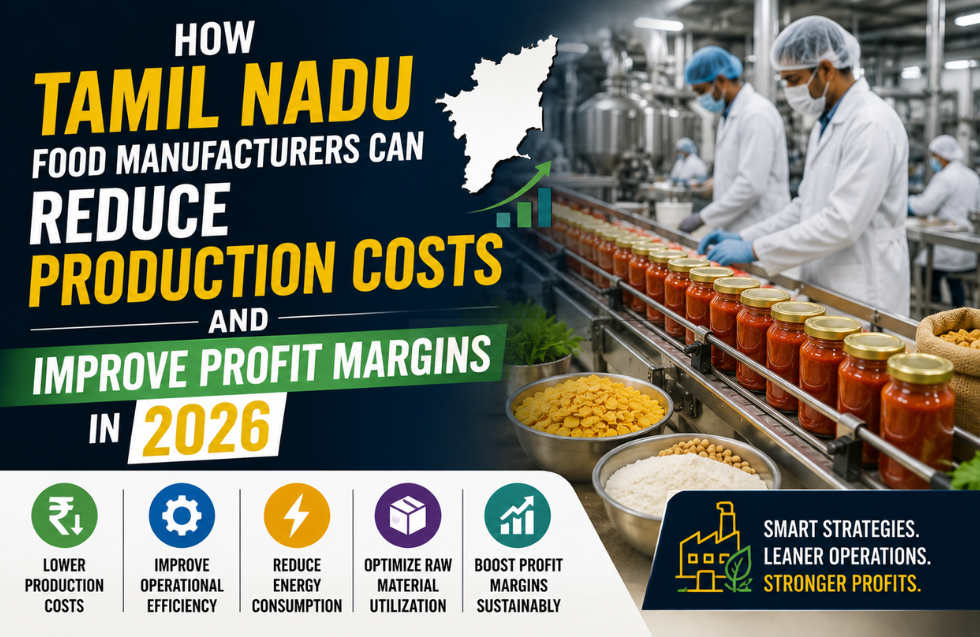
Food manufacturing costs are rising across Tamil Nadu, but many businesses are still losing revenue through hidden operational inefficiencies. As industrial electricity tariffs increased by 3.4% to ₹7.5/kWh in FY 2026 and raw material prices surge 8-10%, food manufacturers face unprecedented pressure on profit margins. This comprehensive guide explores practical cost reduction strategies that actually work for Tamil Nadu’s food manufacturing industry.
Rising Operational Challenges in Tamil Nadu Food Manufacturing Industry
Current Economic Landscape
Tamil Nadu’s food manufacturing sector is experiencing significant headwinds in 2026. The state led India with an average manufacturing growth rate of 9.38% from 2021–22 to 2024–25, but food manufacturers face unique challenges.
Key operational challenges include:
| Challenge | Impact |
| Rising electricity tariffs | 3.4% increase to ₹7.5/kWh for industrial consumers |
| Raw material price fluctuation | 8-10% average increase in input costs |
| LPG/fuel cost issues | Brent crude surged 32% amid West Asia conflict |
| Labour shortages | Skilled workforce availability below 30% in some areas |
| Packaging cost increases | HDPE prices jumped 56%; polystyrene up 32.68% |
| Competitive market pressure | Difficulty raising prices in saturated markets |
Major manufacturing hubs affected: Coimbatore, Erode, Salem, Tirupur and Chennai are experiencing these pressures most acutely. Tirupur, in particular, is the heart of India’s coconut industry where many food processors operate.
Why Profit Margins Are Shrinking for Food Manufacturers
Rising EB & Energy Costs (Tamil Nadu)
The Tamil Nadu Electricity Regulatory Commission (TNERC) implemented a tariff revision effective July 1, 2025, increasing industrial electricity charges by about 3.16% under its annual adjustment mechanism.
For High Tension (HT) industrial consumers, the base energy rate increased from ~₹7.25/kWh to ~₹7.50/kWh. However, the effective cost per unit is higher due to demand charges, fuel cost adjustments, taxes and time-of-day (peak-hour) surcharges.
During peak hours, total effective costs can rise to around ₹9.8/kWh, depending on usage pattern and category.
Since electricity accounts for roughly 15–25% of production costs in food manufacturing, these revisions directly affect margins. As a result, load shifting and energy-efficient production planning are becoming increasingly important for cost control.
Skilled Labour & Workforce Challenges
Food companies in Tamil Nadu struggle to retain skilled operators and production staff. During past disruptions, labour availability in food, FMCG and essential commodity factories dropped below 30%. Companies like Aachi Masala had to hire local workers to reach 80% staff capacity after production fell below 50%.
The challenge persists in 2026 with new Labour Codes effective November 21, 2025, requiring adaptation in workforce management.
Production Wastage & Inventory Loss
Food waste is one of the biggest problems in the industry, impacting the entire manufacturing process. Raw material wastage, overproduction and inefficient stock management can cost manufacturers 5-15% of total production value.
Supply Chain & Logistics Inefficiencies
Transportation delays, higher freight costs and distributor challenges compound margin pressure. Companies have increased product prices by 3-7% on average over recent months just to offset rising input costs.
Price Competition & Reduced Margins
With raw material basket costs increasing 8-10%, companies face difficulty passing costs to consumers in competitive markets. Further price hikes and grammage cuts are likely in food and beverage products as companies scramble to offset inflationary impact.
Food Manufacturing Cost Reduction Strategies That Actually Work
Process Optimization
Reducing unnecessary operational steps and downtime is the most effective way to control unit cost, not aggressive cost cutting. Practical focus areas include:
- Measure losses at the operation level, not just in financial reports
- Standardise work across shifts and operators
- Track productivity and downtime daily
- Fix root causes instead of compensating with extra effort
Making a move to energy efficiency can significantly reduce costs. Switching to energy-efficient LED lighting and Energy Star-rated equipment helps reduce facility energy consumption.
Better Inventory & Production Planning
Managing stock efficiently reduces wastage and holding costs:
- Keep an eye on wastage and reduce it through portion sizing and daily prep lists
- Use food cost formula: Food cost percentage = total cost of ingredients/menu item price
- Target 15-30% food cost percentage for optimal revenue
- Implement ERP systems for proper stock management and budgeting
Vendor & Procurement Analysis
Improving supplier management and purchasing strategy:
- Develop relationships with suppliers to negotiate deals
- Buy in bulk for best deals
- Consider less expensive ingredient alternatives when quality permits
- Monitor raw material price trends to time purchases optimally
Operational Efficiency Monitoring
Track production performance, wastage and machine utilization daily:
- Create routine maintenance plans to prevent breakdowns
- Rethink facility layout to facilitate efficient processes
- Install better drain systems for food plant efficiency
- Improve quality control measures
Branding & Market Positioning Improvements
Improving pricing power through stronger brand perception allows manufacturers to maintain margins despite input cost increases. Companies with recognized brands can pass on 3-7% price increases more easily than generic producers.
How Leading Tamil Nadu Manufacturers Improve Operational Efficiency
Real Industry Example:
Apex Coco – Coconut Processing Company Revenue Growth & International Expansion
Apex Coco and Solar Energy Limited, located in Tirupur (heart of India’s coconut industry), demonstrates how operational improvements drive growth.
Initial Business Challenges
- High overhead costs during initial developmental phase
- Moderate capacity utilization at 37.5% in FY24
- Extended receivables and working capital pressure
- Vulnerability to coconut price volatility
Operational/Process Improvements
- Achieved 87.5% capacity utilization in 5mFY26 (up from 37.5%)
- Implemented automation, hygiene, and sustainability with zero-waste operations
- Installed 30 MW solar power plant (5 MW captive consumption) reducing energy costs
- Obtained global quality certifications: ISO 22000, FSSC 22000, USDA Organic, EU Organic, Kosher, Halal, BRCGS
- Vertical integration – processes every part of coconut for maximum value extraction
Market Expansion Strategy
- Exports reaching 15 countries, contributing 42% of total revenue
- Diversified customer base including Mars, Kevin’s Natural Foods, Dabur, Marico, ADF Foods
- Product diversification: virgin coconut oil, coconut milk, desiccated coconut, coir fiber, coir pith
Revenue Growth Support
- Operating income grew from ₹88.24 crore in FY23 to ₹228.76 crore in FY25 at CAGR of 61.01%
- H1 FY2025-26 sales: ₹241.18 crore, exceeding previous year’s total revenue
- PBILDT improved from ₹20.06 crore (FY24) to ₹37.87 crore (FY25)
- Capital structure improved from negative networth to 0.85x gearing
International Opportunity Identification
Apex Coco’s success demonstrates how Tamil Nadu manufacturers can:
- Target health/wellness trends (coconut water, low-fat desiccated coconut, virgin coconut oil)
- Supply global food manufacturers with premium ingredients
- Leverage Tamil Nadu’s proximity to coconut-producing regions (Tamil Nadu, Kerala, Andhra Pradesh, Karnataka)
When Food Manufacturing Businesses Should Consider Operational Consulting
Food manufacturing businesses should seek operational consulting when experiencing:
| Situation | Warning Signs |
| Rising operational costs | EB bills increasing 3-5% quarterly, raw material costs up 8-10% |
| Low profit margins | PBILDT margins below 10-12% |
| Scaling difficulties | Capacity utilization below 60% |
| Production inefficiencies | Daily downtime, inconsistent quality, high wastage |
| Market expansion planning | Wanting to export but lacking certifications |
| Distribution challenges | Freight costs rising, delivery delays, distributor issues |
The most effective consultants help measure losses at operation level, standardize work across shifts and fix root causes rather than symptoms.
Manufacturing Efficiency Strategy Session
Ready to reduce your food manufacturing costs and improve profit margins?
Schedule a 30-minute consultation to explore opportunities for operational optimization, process improvement and sustainable growth for your food manufacturing business.
What You’ll Get:
- Quick operational insight discussion – Identify your top 3 cost reduction opportunities
- Production efficiency review – Benchmark your capacity utilization against industry standards
- Competitor benchmarking insights – Learn how leading manufacturers like Apex Coco achieved 61% CAGR growth
- Energy cost analysis – Understand how the 3.16% tariff hike impacts your bottom line
- Raw material strategy – Navigate 8-10% input cost increases effectively
This consultation is designed for manufacturers across Coimbatore, Erode, Salem, Tirupur and Chennai, especially in food processing, coconut processing, FMCG and beverage production.
If your business is dealing with rising costs, shrinking margins or scaling challenges, now is the time to act. Hidden operational inefficiencies could be steadily eroding your profits.
With food manufacturing costs increasing across Tamil Nadu, companies that adopt the right cost-control and efficiency strategies can still maintain strong profitability.
Book your consultation today atOur business ladder and start optimizing your operations for better margins and sustainable growth.