Imagine this: shoppers wander through a busy supermarket, shelves stacked high with snacks, beverages and personal care items.
- One new FMCG product grabs attention with striking packaging and a promise of “gut-friendly refreshment.”
- They pick it up, try it out and it quickly becomes a staple.
Such success rarely happens by accident. In the competitive FMCG sector, where 80 to 85 percent of launches fail from poor research or intense rivalry, careful planning proves essential.
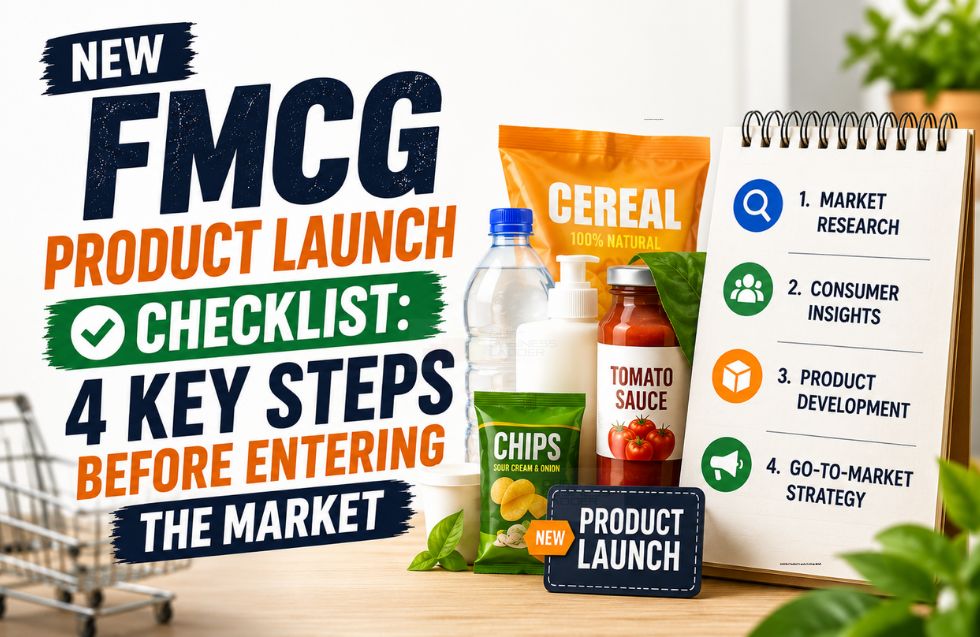
This guide covers competitive market analysis, the most important things to know before launching an FMCG product, how to launch a new FMCG product in the market step-by-step, real-world style examples and why market research is the backbone of any successful launch.
What Is an FMCG Product?
Fast-Moving Consumer Goods (FMCG) are low-cost products that sell quickly and are purchased frequently. Common examples include:
- Packaged foods and snacks
- Beverages (soft drinks, juices, flavored milk, energy drinks)
- Personal care products (soaps, shampoos, toothpaste, deodorants)
- Home care items (detergents, dishwash liquids, cleaners)
Margins per unit are usually low, so profitability comes from volume, repeat purchase and efficient operations. A profitable FMCG product is one that consumers pick again and again because it delivers consistent value, fits their lifestyle and is easy to find across channels.
Why Market Research is Important in FMCG Product Launch
Market research forms the backbone of any FMCG product launch. It reveals true consumer desires and spots overlooked gaps. Neglecting it and efforts target unwanted items and contribute to high failure rates.
This step acts as an early alert. Surveys and analytics highlight changes, such as:
- The boom in plant-based snacks
- Low-sugar options in 2026.
Platforms like Nielsen or Google Trends identify these shifts for perfect alignment. Hip Pop’s probiotic soda succeeded by researching gut health trends, securing awards and prime placement.
Clear examples illustrate the impact:
- One beverage firm adjusted flavors through focus groups, lifting trial rates by 40 percent pre-launch.
- A snack producer reviewed buying patterns, launched protein-rich bars and created a top seller.
Research turns guesses into smart moves.
Step 1: Competitive Market Analysis – Find a Real Gap
Before deciding flavor, pack, or tagline, you need to know where you stand in the existing battlefield. Competitive market analysis helps you avoid becoming just another “me-too” product.
Focus on:
- Who are your main competitors?
Identify 3-5 brands in your category, e.g. salty snacks, instant noodles, herbal shampoo, surface cleaners.
- What do they have?
Look at their price points, pack sizes, ingredients, claims (e.g. “no added sugar”, “herbal”, “long-lasting”) flavors, packaging design and promotions.
- Where are they strong?
Find out which channels they dominate: general trade (kirana), modern trade (supermarkets/hypermarkets), e-commerce, or quick-commerce.
- Where is the gap?
Identify unmet needs (kids, health-conscious, regional tastes), usage occasions (on-the-go, late-night, travel), or formats (sachets, family packs, refill packs).
Example:
If you notice most bathroom cleaners focus on “germ kill” but very few mention “low odour” or “gentle on surfaces”, you can give your new FMCG product a positioning of safe, low-smelling cleaning for families with kids and elders.
This step is what determines your positioning and the core of your communication and pricing strategy.
Step 2: Market Research – The Backbone of an FMCG Product Launch
Market research is where assumptions turn into insights. Skipping this step is one of the most common reasons FMCG launches fail.
Key research components:
- Consumer insights
- Who do you think will be your chief user and purchaser?
- What issue is the user aiming at the flavor health ease, cost, or environment-friendliness?
- Which items are they currently going for and what are their problems?
- Concept and pack testing
- Introduce your idea, its advantages and even the packing to consumers (Besides you can draw them yourself).
- Ask: “Would this product be of your interest?”, “What is it that you fancy or don’t?”, “Which variant or pack would be of your choice?”
- Price sensitivity
- Different prices and packs (like 10 vs 15 vs 20) can be tried to pinpoint a good balance between perceived value and margin.
- Trade feedback
- Discuss with retailer, wholesaler about margin expectation, shelf space, sales and what can help them push your brand (schemes visibility POS material).
Example:
A new healthy snack brand might find that people are willing to pay a little more if the packaging clearly states “no maida”, “baked not fried” and also offers a handy resealable pouch. Such knowledge impacts product development, pricing and packaging all at the same time.
Step 3: Things to Know Before Launching an FMCG Product
After defining the consumer and competition it’s time to ask yourself if your product is really ready to meet the real world.
It is advisable that you first run through your product launch checklist internally:
Product readiness:
- The final aspects of product eating qualities, texture, aroma and effectiveness were checked.
- Tested the shelf-life and stability of products under relevant climate and storage conditions.
Packaging & compliance:
- Your packaging should be something that protects the product and has the ability to catch customer attention on shelves.
- Make sure that all the information that has to be legally included is there: list of ingredients, nutritional information panel, net quantity MRP dates, license numbers, consumer care details.
- Claims made are compliant and can be backed up (e.g. “sugar free”, “high protein”, “natural”).
Operations & supply chain:
- Raw material sourcing is reliable and costly.
- Production capacity matches launch targets.
- Plans for logistics and inventory are coordinated so that there will be no cases of running out of stock or products expiring.
Financial viability
- Make sure to include in the costs: trade margins and consumer offers.
- Preliminary assessment of break-even volumes and contribution margins.
These factors guide the sustainability of your FMCG product launch and will still be there after the initial excitement dies down.
Step 4: How to Launch a New FMCG Product in the Market
Now you’re ready to translate planning into action. Think in three phases: pre-launch, launch, and post-launch optimization.
4.1 Pre-Launch: Set the Stage
- Identify your target segment and positioning clearly.
- For example: “Value-focused family detergent for tough stains” or “Fun, portion-controlled chocolate snacks for kids.”
Set measurable goals
- Number of outlets, regions, sales targets, trial and repeat metrics, awareness or reach.
Final pack and channel strategy
- Smaller price-point packs for kiranas, medium packs for modern trade, value packs or combos for online.
Create excitement around the upcoming launch
- Posting teasers, providing products to influencers, doing trials in societies/colleges/offices and pilot launches in limited regions.
4.2 Launch: Drive Visibility and Trials
Ensure availability before advertising.
- The fastest way to ruin a customer’s trust is to promote a product extensively only to find that it is unavailable.
Carry out integrated marketing
- In-store branding (shelf strips wobblers end-caps).
- Digital campaigns on platforms that your target audience actually uses.
- Influencer content, local events and sampling.
Offer the customers sampling and introductory offers
- BOGO (buy one get one), combo packs, on-pack coupons, or free trial sizes with complementary products to catalyze first-time use.
4.3 Post-Launch: Analyze, Refine, and Extend
Keep an eye on KPIs right from launch day
- Sales per outlet, repeat orders from the trade, consumer reviews and ratings, social media mentions.
Make fast adjustments
- Perhaps a flavor isn’t appealing, a message isn’t sufficiently clear, or a price point is negatively impacting sales. In that case, make refinements quickly.
Develop a plan for scaling up
- When a hero SKU and a winning message are defined, going forward, roll out to new geographical regions, channels and variants.
Standout FMCG Product Launch Examples from 2025-2026
Victories inspire action.
- Graze bean crisps capitalized on spices via precise promotion.
- Hip Pop’s fiber soda highlighted wellness perks.
- Chocolates and snacks grew through diversity amid hurdles.
- Portioned snacks matched health needs spot-on.
Research, differentiation and timing fueled these triumphs.
Pitfalls to Avoid in Your Launch
- Skip deep research and results suffer.
- Ignore supply lines and stock vanishes.
- Overlook 2026 wellness moves and interest fades.
- Adapt based on fresh data.
Top 5 FAQs on FMCG Product Launch
1. What is an FMCG product?
An FMCG product is a fast-moving consumer goods that sells quickly at a low cost, such as snacks, beverages, personal care items and household cleaning products.
2. How much time does an FMCG product launch require?
Generally 6 to 12 months from research through shelving, varying by complexity.
3. What creates a profitable FMCG product?
Long shelf life, cost efficiency, and alignment with health trends help create profitable FMCG products, as seen with coconut powder successes.
4. Why focus on market research for FMCG product launch?
It exposes demands and niches, cutting 80 percent failure chances in competitive 2026 scenes.
5. What tools aid competitive analysis?
GreyB methods, Nielsen stats and shelf audits for rates and strategies.
Wrapping Up Your Path to Launch Success
A new FMCG product launch brings excitement and hurdles, yet this checklist brings order. Prioritizing research, honing competitive strengths, polishing development, plotting rollout and syncing teams paves the way for growth. 2026 trends in wellness and AI open doors, but strong follow-through seals deals. Companies embracing these not only endure but excel, transforming routine purchases into must-haves. Begin with research now, refine along the way and see ideas thrive on shelves. The road to a thriving FMCG product launch lies ahead.
Follow this blueprint for success. Dive into research, beat the competition and embrace trends. Got a product idea? Share thoughts below.