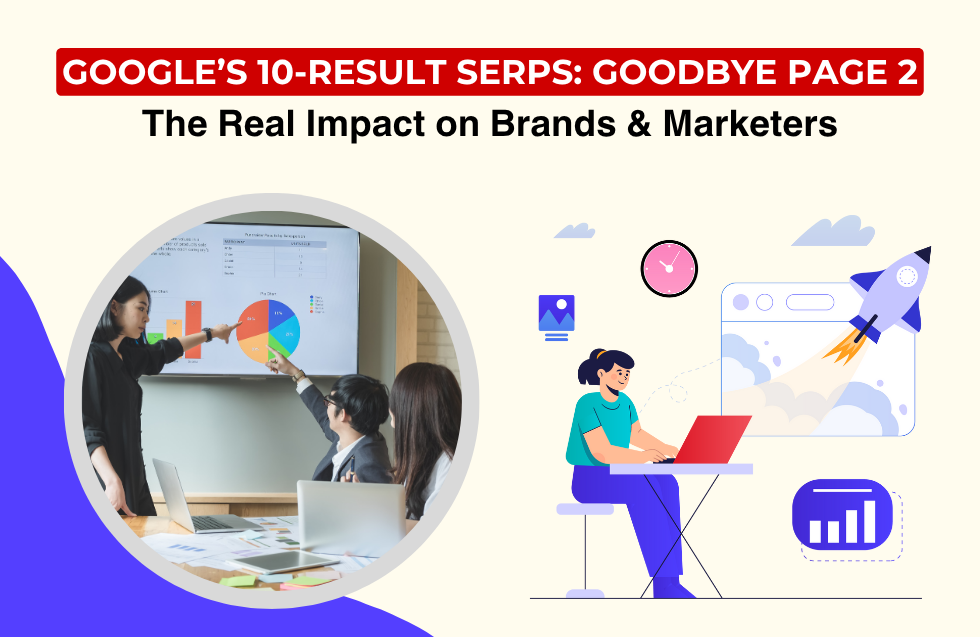
Something huge happened in 2025, quietly: Google took action to limit search engine results pages (SERPs) to 10 meaningful results. In other words, the existence of a “Page 2” no longer matters. This is not a trivial or superficial change, it is impacting how visibility, branding and marketers ought to think about SEO, discovery & authority.
Here, we examine:
- What Google 10-result SERPs actually mean
- How it alters visibility, tracking and zero-click dynamics
- The future of search in an AI world
- How brands and marketers evolve to remain in the game
What Are Google SERP Results?
SERP is an acronym which stands for “Search Engine Results Page”. This is the page, which a search engine like Google displays when searching for something containing organic links, ads, snippet previews, maps and more.
A “SERP result” most commonly refers to one of the organic listings (the “blue links”). But more and more, SERP features (such as knowledge panels, AI Overviews and featured snippets) take up screen real estate and alter user behavior. New research indicates that all these features potentially contribute to a dramatic impact on click-through rates and overall traffic generated for organic results.
What are the two types of results on Google’s search page?
This is a frequent question and the answer will vary depending on what you group them under.
Organic (Non-Paid) Results
- The classic “blue link” listings from websites that are ranked by Google’s algorithm
- These remain crucial to SEO, although their dominance is being challenged
Featured / Rich / AI-Driven Results
- These encompass knowledge panels, featured snippets, People Also Ask (PAA), local map packs, AI Overviews and search generative summaries
- These tend to come above or between the natural listings and sometimes substitute or lower the visibility of the traditional links
So basically, Google displays natural results + rich SERP features (enhanced features). As time goes on, enhanced features are becoming more dominant, particularly for informational searches.
How Does Google Display Results for “Near Me” Keywords?
When people search using “near me,” Google strongly favors local intent and map-based results. The SERP will typically feature:
- A map pack / local map with pins indicating surrounding businesses
- Business listings with address, phone, hours and review blurbs
- Potentially featured snippets for local queries
- Geographically filtered organic listings
Since “near me” searches are usually transactional or navigational, Google would like to show the most geographically relevant businesses first which means your local SEO and Google Business Profile are essential.
The Shift: Why Google 10-Result SERPs Are a Turning Point
Google Limits SERPs to 10 Results
Around mid-September 2025, SEO experts and their resources noticed Google eliminated the &num=100 parameter from their results factor. This was a move by Google to stop users (or bots/spiders) from affecting their results to show 100 results on one page. The limit is essentially 10 at this point.
This has deep ripple effects:
- Rank-tracking tools and bulk result scrapers that depended on mass result extraction are disrupted.
- Most sites experienced sudden decreases in reported impressions and “average position” changes.
- It puts paid to the idea of deep-SERP occurrence: your content below the top 10 will never be viewed.
AI Overviews & Zero-Click Domination
Before the 10-result limit, Google was already moving towards AI-created summaries. These AI Overviews pop up above or between regular results, summarizing information in real-time and sometimes eliminating the need to scroll or click.
The statistics indicate that when there is an AI Overview, it takes clicks away from organic results. According to studies, there is a 34.5% decline in CTR for position 1 when there is an AI Overview displayed. So, even when ranking within the top 10, your actual visibility and traffic are being suppressed by these “rich” layers.
Search Is Becoming “Discovery”
SEO is shifting from chasing keyword rankings to creating content that’s discoverable across AI tools, chat assistants and interactive SERP features. Google’s AI Overviews now serve as content curators, deciding which sources to highlight.
The idea that “rank 1 = traffic” is being discredited; now it’s a matter of which sources are mentioned or highlighted in AI-generated summaries.
The Actual Impacts on Brands and Marketers
1. Brand Visibility Becomes More About Being Featured, Not Just Ranked
- Ranking well isn’t sufficient anymore, brands need to be chosen by Google’s AI to be quoted in overviews, featured snippets or answer cards.
2. CTRs and Traffic Go Down for Non-Branded, Informational Search Queries
- With organic links moving further down or disappearing under AI blocks, click-through rates are dwindling, even for top-ranking pages.
- For publishers and news in particular, traffic falls have been steep: some experienced decreases in click volumes by 50–80% when AI overviews are present.
3. SEO Tools and Metrics Shake Up
- Rank-tracking products, scrapers and analytics platforms need to change. The removal of the &num=100 parameter compelled numerous platforms to reconsider how they scrape and show ranking data.
- Traditional metrics like “average position” are becoming less useful. Instead, marketers will start tracking mentions, AI visibility, brand reach and real conversions.
4. Deep Content (Page 2–3) Mostly Vanishes
- Your long-tail pieces of content, content depth or freshness that were seen deep on Page 2 are not likely to ever get surfaced. The pressure is on for optimizing the top 10 immediately and reconsidering content strategy.
5. The Age of Generative Engine Optimization (GEO) / Answer Engine Optimization
- With AI-powered search and answer engines becoming increasingly common (ChatGPT search, Google AI features, LLMs), optimizing for being part of AI answers becomes critical. It is commonly known as GEO or Answer Engine Optimization (AEO).
- Authoritative, structured, properly-cited content works best with generative engines in synthesized answers.
How Brands & Marketers Can Transition (Future-Ready Strategy)
A. Optimize for AI Overviews & Snippet Eligibility
- Employ clear, sharp definitions, lists, “how to” instructions, FAQs and tables formats that AI devours
- Organize content so Google can extract atomic answers
- Utilize schema, structured data and crisp headings
B. Establish Brand Authority & E-A-T
- Since AI tends to cite sources, brand authority and trust become essential
- Publish original research, data and high-credibility content
- Get quoted by high-authority sources others linking to you raises the probability of selection
C. Prioritize Discovery, Not Just Rankings
- Be present in various formats: videos, images, local listings, podcasts, apps
- Omnichannel thinking: voice, chat, AI assistants and content aggregators
- Employ brand awareness campaigns: to prep recognition, recall assists when AI must decide which brand to quote
D. Rethink Content Strategy: Quality Over Quantity
- High-value, evergreen, properly constructed content
- Shrink the pursuit of infinite keywords and instead target fundamental subjects that AI may quote
E. Watch AI Signals & Metrics
- Monitor mentions, citations, AI visibility as opposed to rankings
- Utilize tools or dashboards that indicate when your content is quoted in overviews
- Monitor “impression drops,” volatility or abnormal changes following Google tests
FAQs (People Also Ask & Future Trends)
1. What are Google SERP results?
They’re the organic and enriched listings that Google shows when you search such as traditional blue links, featured snippets, local packs and AI Overviews.
2. What are the two main categories of results on the search page of Google?
- Organic (non-pay) results
- Enhanced or AI-based results like snippets, AI Overviews, PAA and knowledge panels.
3. How does Google display results for “near me” keywords?
It puts a spotlight on local outcomes such as maps, listings and location-based ranks customized based on the user’s geographic intent.
4. Why did Google limit SERPs to 10 results?
To curb scraping, cut down automated bulk result fetching and manage deep-SERP exposure. This shift also complies with Google’s shifting AI-focused interface.
5. Do AI Overviews murder organic traffic?
Yes, to an extent. Studies show AI overviews reduce clicks to traditional results, especially for informational and non-branded queries.
6. How do brands stay visible in this new 10-result + AI world?
By optimizing for snippet eligibility, building brand authority (E-A-T), focusing on AI-friendly content structures and measuring AI citations rather than just ranks.
Conclusion: The Future of Search Is Here
“Page 2” is no more but that doesn’t make chances disappear. Success now lies in being recognized by AI and chosen as a trusted source. The move to 10-result SERPs and the reign of AI Overviews revolutionizes the game of visibility. Brands and marketers need to adjust from rank-chasing to authority-crafting, structuring and AI relevancy.
In this new age, getting cited, believed and AI-optimized for answers counts more than ever before. The champions won’t only rank, they’ll be selected by Google’s AI as the preferred sources. It’s time to go full speed on your content strategy to generative visibility.
Also Read: Why SEO Growth in 2026 With Strategic Link Building and Guest Posting