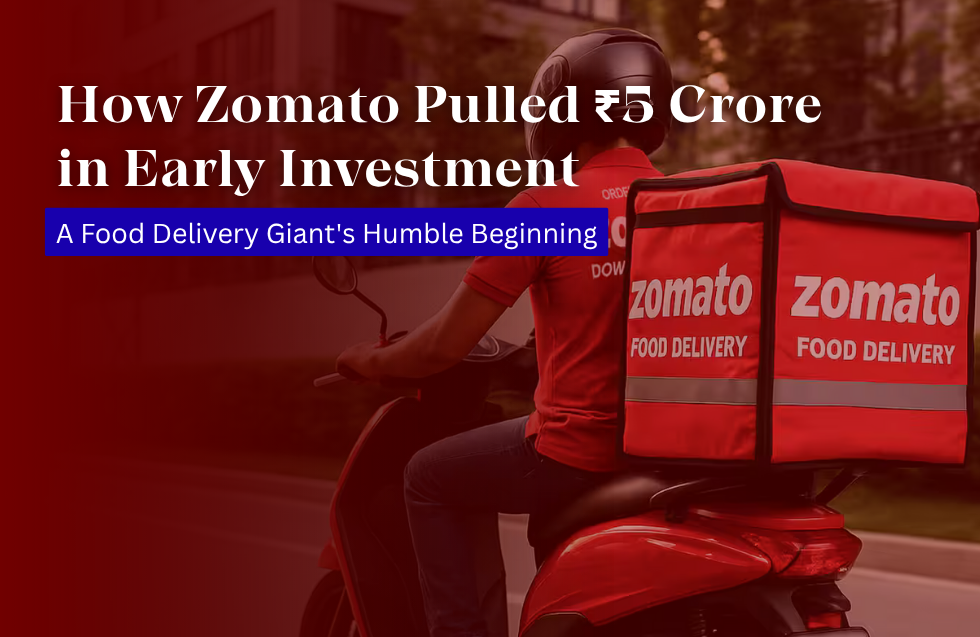
When you think of food delivery in India, one name instantly comes to mind is- Zomato. What many don’t know is that behind this billion-dollar food-tech empire lies a humble beginning, powered by a bold vision and a modest Zomato early investment of ₹5 crore.
The Zomato early investment saga is a masterclass in timing, execution and perseverance. From humble beginnings as a humble restaurant menu directory to being a publicly traded food-tech giant, Zomato’s tale is a compelling mix of grit and innovation.
1. The ₹5 Crore Beginning: Zomato’s First Big Break
In 2008, two graduate friends of IIT Delhi, Deepinder Goyal and Pankaj Chaddah, worked at Bain & Company. They saw some colleagues lining up one by one for days to see restaurant menus stuck in the cafeteria. It gave them a simple idea: what if restaurant menus everywhere could be accessed online?
They developed FoodieBay, a site that allowed users to surf through the menus of restaurants nearby. The idea caught on right away. By 2010, when user volumes erupted, the founders realized they were onto something massive. That’s when their first serious investor came along Info Edge (India) Ltd., which invested nearly ₹5 crore (approximately US$1 million then).
This Zomato early investment became the crucial push that transformed a simple idea into a national movement. It helped the founders hire their first engineers, expand into new cities and upgrade servers, small steps that built the foundation of a global food delivery revolution. That initial ₹5 crore was the seed for what would become one of India’s greatest startup successes.
2. From FoodieBay to Zomato: A Clever Rebrand
In 2010, FoodieBay was experiencing growth as a business. So the founders Pankaj Chaddah and Deepinder Goyal decided to take the company on an international scale, they believed the name would limit the brand’s potential. Thus, they opted to relaunch the business name as Zomato which was short, catchy and sounded much more international.
The rebranding wasn’t just a name change, it was a statement of intent. The founders envisioned a platform that would go beyond menus to become a full-fledged food discovery and delivery ecosystem. That vision would later define Zomato’s early investment success story. That change in thinking brought in more investors and changed Zomato’s perception from a college project to a true startup poised for expansion.
3. The Key Drivers of Zomato’s Initial Success
Zomato’s initial success was not a coincidence. It was aided by a sound plan and intelligent action. That is what succeeded:
a) Solving an Actual Pain Point
Before Zomato, accessing restaurant menus or reviews online was a chore. Zomato solved the pain point by offering an ease to use, data-rich platform.
b) Timing and First-Mover Advantage
Purchased in the midst of India’s smartphone and internet growth, Zomato was one of the first to be in the restaurant discovery category. This provided it with an advantage prior to increasing competition.
c) Strategic Use of Capital
Zomato early investment wasn’t spent on frivolities. Founders were committed to sustainable growth, tech building, enhancing data accuracy and city by city growth.
d) A Strong Product-Market Fit
The site rapidly turned into a daily routine for users in cities. Individuals believed in Zomato’s listings and reviews and helped build a loyal following.
e) A Founder Who Thought Long-Term
Deepinder Goyal did not pursue short-term profits. He was aware that profitability would come in the form of scale and efficiency, not discounts or hype.
4. Challenges Early On and How Zomato Battled Them
| Challenge | How They Overcame It |
| Limited resources and funding | They focused on sustainable growth and robust data accuracy prior to scaling. |
| Getting restaurants to go online | Provided free listings and online visibility, delivered value through user interaction. |
| Local player’s competition | Remained committed to product quality, user experience and brand consistency. |
| Delivery and logistics challenges | Originally collaborated with third-party delivery companies, subsequently acquired Runnr to dominate logistics. |
| Cash burn during growth phase | Restricted marketing spends and enhanced order economics with data-driven learnings. |
Each challenge was a learning lesson, making Zomato more adept at innovation and adapting.
5. When Zomato Began Delivering Food
Zomato was merely a restaurant discovery platform until then.
But in 2015: Entering the food delivery market for the first time, Zomato opted for third-party logistics to manage deliveries for restaurants that didn’t have their own fleets. Taking over the logistics as orders grew, Zomato bought a delivery startup, Runnr, in 2017 to further beef up its logistics network.
What followed was a transformation from being an information platform to being an end-to-end food delivery ecosystem.
6. Zomato’s Funding Journey: From ₹5 Crore to Billions
The Zomato early investment was only the start. Over the years, Zomato took capital from some of the globe’s best investors:
- 2010: ₹5 crore from Info Edge
- 2011–2013: Various rounds from Info Edge and Sequoia Capital
- 2014–2015: Over $100 million in funding as the company went global
- 2020: Uber Eats India acquired for $206 million
- 2021: Zomato’s record IPO, which made it one of India’s earliest food-tech unicorns to list on the stock market
Overall, Zomato has raised over $1.5 billion in over nearly two decades. That early confidence with investors like Info Edge led to a fortune running into thousands of crores.
7. Intelligent Acquisitions: Uber Eats India and Blinkit
Zomato’s growth strategy wasn’t only organic—it was through intelligent acquisitions.
Uber Eats India
Uber Eats India was also bought by Zomato in 2020 in an all-share transaction valued at $206 million. This took out a direct competitor and doubled the customer base and delivery network of Zomato overnight.
Blinkit (former Grofers)
In 2022, Zomato made one more giant leap by acquiring Blinkit, the delivery app for quick commerce, in an all-stock deal worth ₹4,447 crore. The acquisition enabled Zomato to enter the fast-rising 10-minute grocery delivery business and move its business away from food.
These buyouts turned Zomato a leader not only in ordering food but also in India’s fast-growing quick commerce economy.
8. Deepinder Goyal: The Founder of Zomato
Deepinder Goyal is the CEO of Zomato is one of India’s most leading capitalists. His story is one of diligence, humility and guts.
He sourced a simple, resolute idea, put down his savings to self-fund it and sold early investors on data and conviction-not hype. Even in busts, he has always chosen a long-term vision over short-term trends.
Deepinder’s belief was always clear: First, build for the consumer and everything else will follow.
9. Blinkit, Zepto and Market Comparisons
Nowadays, people tend to speculate about the relationship between Zomato and other quick commerce players:
- Blinkit: Wholly owned by Zomato post-2022 acquisition.
- Zepto: An independent company that Zomato does not own.
Comparison of Profitability: Blinkit and Zomato both compete in capital-intensive markets. Zomato’s delivery business is almost breakeven, while Blinkit is expanding faster in terms of order volumes and valuation potential.
Both the brands are at the heart of Zomato’s future in its “super-app” ecosystem vision.
10. What’s Coming Next: Zomato’s Future
Zomato’s future appears bright but challenging. Here’s what comes next:
- Integration of Food and Grocery Delivery
Merging Zomato and Blinkit’s networks to streamline delivery routes and reduce expenses.
- Profitability Focus
Following years of aggressive expenditure, Zomato is now concentrating on unit economics so that each order adds to profits.
- Technology and AI
Utilizing of data analysis, route optimization and personalization will improve the customer experience.
- Brand Evolution
In 2025, Zomato announced that they would be rebranding to “Eternal”, which was intended for their long vision of becoming an ecosystem in food, grocery, events and more.
- Expanding Beyond India
Although India is the main market, Zomato will resume operating in strategic international markets once profitability is back on track.
FAQs
1. In which year did Zomato initiate food delivery?
A: Zomato initiated food delivery in 2015 by, serving food providers prior to establishing their own standalone delivery company in 2017.
2. How was Zomato funded?
A: Zomato raised 5 crores in its initial funding round of 2010 from Info Edge, and then went on to do several rounds of funding in which they raised more than $1.5 billion altogether, before it went to launch its IPO.
3. Does Zomato own Zepto?
A: No, Zepto is a standalone company unconnected with Zomato.
4. Who owns Blinkit really?
A: Post acquisition, Blinkit had become a completely-owned subsidiary of Zomato (now belonging to the Eternal group).
5. Is Blinkit more profitable than Zomato or not?
A: Blinkit has excellent growth potential, but currently Zomato’s food delivery business is more lucrative. Profitability is a matter of efficiency and scale.
Conclusion
From a seed investment of ₹5 crore to a valuation of a billion dollars, Zomato early investment is the foundation of one of the most inspiring startup success stories in India. It is the proof of the trust in early investors, vision of the founders and desire of a nation for digital transformation.
Zomato’s transition from FoodieBay to Eternal proves that an idea, fueled by conviction and wise action, can transform an entire sector.
For one, Zomato early investment’s story is about belief, ingenuity and the courage to build something remarkable.
Also read: Why AI Delivery Agents Are the Next Big Thing in Supply Chain Automation