
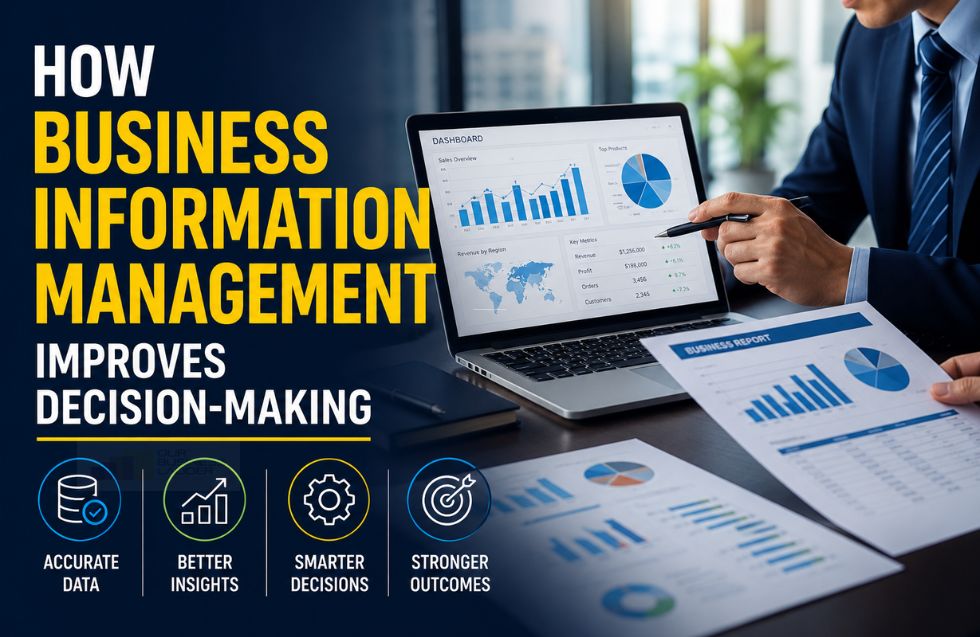
Business Information Management refers to a methodical approach to information gathering, preserving, processing and sharing in order to assist the organization’s objectives. It is a means of making intricate data understandable and thereby supporting planning, strategy and even daily operations. The way an organization captures, organizes and utilizes data determines the confidence level of making smart, informed choices. That’s where Business Information Management or BIM, comes in: the backbone of every successful decision-making process.
Businesses of today generate a lot of information every minute. Sales numbers, customer evaluations, market analysis and financial data all come in different flows. Without a system that organizes and controls the information, this is simply noise instead of knowledge. We will explore and unpack the way Business Information Management converts raw data into actionable strategic insights and why it is the foundation for good decision-making.
What is Business Information Management?
Business Information Management is a structured process for information collection, storage, analysis and distribution to support an organization’s goals. It helps convert complex data into usable insights that guide planning, strategy and daily operations.
Instead of instinct or guesswork, BIM ensures that decisions are taken based on facts and figures. It involves:
- Collecting information from various sources – accurate, appropriate.
- Store data securely in databases or cloud platforms.
- Analyzing information through software tools, such as a dashboard or analytics system.
- Distributing results to the teams and decision-makers operating at all levels
In many ways, BIM helps to ensure that the right information is delivered to the right person at the right time so they can make the right decision.
Why Business Information Management Is Essential for Smart, Confident Decisions
Turning Data into Decisions
Without the right infrastructure to manage data, even the best business ideas can fall flat. When information is decentralized among departments, or becomes outdated, decision making can become slow and cumbersome, resulting in poor decisions. A powerful BIM system will give organizations the ability to sort the wheat from the chaff, foresee patterns and take action.
Improving Coordination and Alignment
A well-implemented information management system eliminates confusion and duplication. When each department utilizes the same trusted data source, goals and strategies line up seamlessly. Marketing, finance and operations can work together on cohesive, real-time insights. This creates alignment and efficiency for the company as it is moving forward in one cohesive effort.
Speeding Up Decision-Making
In competitive industries, it’s all about speed. Through a centralized information management system, managers can instantaneously have access to reports without waiting for manual updates. Real-time analytics and dashboards serve to help leaders understand very quickly what’s working and what doesn’t and what needs urgent attention.
Reducing the Risks and Uncertainty
All choices involve some degree of risk and solid information can dramatically reduce uncertainty. With BIM, firms can review trends, predict the outcomes and identify issues that will arise well before they occur. When data leads the decisions, risk is manageable rather than intimidating.
The Role of Management Information Systems in Business Decision-Making
An MIS forms part of a bigger picture called Business Information Management. In other words, the system is a technological backbone necessary for information capture, storage and analysis. MIS presents data to managers in a structured and summarized manner that enables them to closely assess options and then select the best course of action.
The advantages of using MIS is:
- Having centralized data access means that all departments can trust the same source of truth.
- When reporting is automated, the organization can make better use of human, capital and other resources by not having to manually gather and analyze documents. Automation of reporting removes or greatly reduces human error.
- Predictive analytics will show trending data and inform future planning.
- Decision support provides insight through charts and visuals presented in reports.
- By adopting MIS into regular operations, companies transition from being reactive to proactive in their decision-making process.
Ways in Which Business Information Management Supports Decision Quality
Real-time insights for better control
Automated, cloud-based systems remove at least days of wait time for managers to hear back with an update because they can access the data as timely and accurately as they want or need at each moment in time. If you’re tracking sales, evaluating performance or checking responses of customers, real-time insights will allow quicker and more precise decisions.
Formulate Data-Driven Strategies
BIM will furnish strategic insights that are based on fact and evidence and not on conjecture. For instance, looking at sales trends and customer preferences over a period of time would allow a company to create better marketing campaigns or to develop products that fit market demand. Worldwide leaders such as Amazon and Netflix have perfected the use of information management to forecast what a customer will want, even before the customer knows it themselves.
Encouraging Learning and Improvement
The process of decision-making does not stop at making a choice. A great BIM system offers feedback through the tracking of outcomes and measuring of performance. This circle or loop assists businesses in understanding what worked, identifies what didn’t work and thus changes certain strategies. At the same time, decisions become more accurate.
Implementing Effective Business Information Management
An organization must have a structured plan in order to get the most value from BIM. Here are specific, actionable next steps to start, or further develop, your information management process:
- Find your objectives
Identify the business issues you are trying to address or identify what decisions you want better data to support.
- Assess your existing data
Identify where the information comes from and how it is stored and who uses it.
- Select the right tools
Select software systems which support your company’s needs such as business intelligence systems, analytics systems or cloud-based management information system (MIS).
- Make sure your data is consistent and accurate
Map your data and regularly “clean” it to eliminate old information and errors.
- Encourage openness and collaboration
Foster an environment of data and insight sharing across functions, not just compartmentalization thereof.
- Train the staff to use the system
The best system in the world could be useless if people don’t know how to take advantage of it.
- Measure the effects
Observe how data management improves the time, quality and business impact of decision-making.
Overcoming Common Challenges in Business Information Management
Adoption of BIM does come with challenges. Common business barriers include:
- Data overload actually means the overloading of information. Only the information relevant to the problem to be solved must be focussed upon gathering.
- Issues with data quality: “Bad data” is inconsistent or inaccurate data. It will lead to poor decision making. Make sure you take time to clean and validate your data.
- Fear or resistance to change: Your employees will likely have resistance to the new system. Make sure you explain the benefits and provide training.
- Lack of integration: Scattered data on different platforms creates confusion. Make sure that all systems work in harmony.
- Security: This is about data protection. Clear policies on data governance and access control should be established.
Addressing these issues allows organizations to build a culture of proper information and decision-making.
Business Information Management: Real World Impact
Consider a retail company using BIM to monitor customer preferences in real time through the analysis of purchase histories, seasonal trends and customer feedback in order to predict demand for upcoming products. This will help it stock efficiently, reduce waste and improve profits.
Through advanced information systems, banks in the financial sector make decisions on loan risks. They can analyze patterns in credit history and income data to issue safer loans. Data management allows physicians to make faster, evidence-based diagnoses in healthcare.
Parity exists across industries: the organizations that best manage information also make the best decisions.
Conclusion: From Information to Intelligent Action
Information is the biggest asset for any business. When information is managed properly, it drives every decision from daily operations to long-term strategy. Business Information Management empowers organizations to transform simple data into actionable informing knowledge that helps predict trends, mitigate risk and stay competitive. All great decisions begin with great information.
The real question is, are your business decisions based on data-driven informing knowledge or are they merely guesswork?
FAQs
Q1. In what way does information management assist in decision making?
It provides timely and accurate information to the leaders to make an informed and confident decision.
Q2. Why would a management information system, or MIS be important in decision making?
They take tremendous data, organize it and provide reports that the manager can use to analyze when weighing options.
Q3. What does information play in business decision making?
Information is the foundation of any decision. Information allows managers to reduce their uncertainty and make decisions based on facts rather than assumptions.
Q4. What is the advantage of Business Information management for small businesses?
A number of cost-effective tools are available which can help small businesses track their estimated progress, e.g., spreadsheets and dashboards or through cloud-based applications.
Q5. What are some of the risks of not managing information?
Lack of coordination, less efficient decision making or mistakes that cost money might all be the results of poor business data management.
Q6. How will organizations ensure that their information systems are functional?
Periodic updates, training staff, auditing data and using current technology are all reasons that keep them functional and relevant.