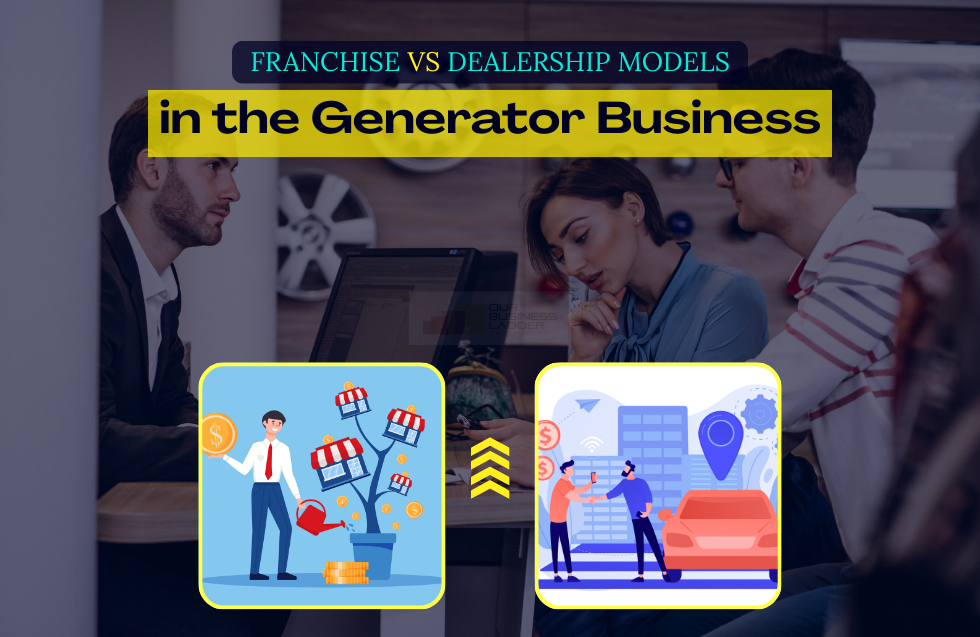
The first major choice that generator business owners need to make involves their decision to operate an independent dealership or become a franchisee. The two business models of independent dealerships and franchise systems both function as viable operations, yet they create distinct differences in three areas of business operations which include control mechanisms and assistance provided to business operators and potential dangers that business owners must handle.
The generator business attracts entrepreneurs because of its combination of two main reasons which make the field appealing to them are
- Steady demand for backup power
- Multiple customer segments (homes, shops, factories, data centres)
- Recurring income from service and AMC (annual maintenance contracts)
In this guide, we’ll compare franchise vs dealership models in the generator business in simple, real‑world terms so you can decide which suits your budget, skills and long‑term goals.
What is the generator business really about?
Before jumping into franchise vs dealership, it helps to understand what the generator business actually involves day‑to‑day.
Typical activities include:
- Selling diesel, petrol or inverter generators (residential, commercial, industrial)
- Providing installation, commissioning and AMC
- Offering spare parts, repairs and emergency breakdown support
You can operate this as:
- A standalone dealership (you choose the brands and build your own brand)
- A franchise (you operate under an established brand with defined processes)
- Both sit under the broader generator business, but the way you run them is quite different.
What is a dealership model in the generator business?
In the dealership model, you sign an agreement with one or more generator brands to sell and service their products in a specific territory. You are essentially an authorized dealer, not a franchisee.
How it usually works
- You select brands (local or international) and negotiate distribution rights.
- You set up your own showroom, warehouse and service team.
- You market your business under your own name or a local brand you create.
Pros of the dealership model
- You can select your preferred brands to sell which products to market and the methods you will use to set prices and conduct promotions.
- You will increase your profit margins because you do not need to pay franchise fees and you will achieve this by managing your expenses effectively.
- You can create a local brand identity which allows you to establish a community presence that exists independently from national corporations.
The dealership model has these drawbacks
- You must create all aspects of your business from the ground up as you need to develop all branding, marketing, training and operational procedures.
- The process of building brand trust takes longer because customers need extra time to develop trust in a new local business which operates against established national and international brands.
- You will receive product training and technical assistance but your business development needs will go unmet since they do not provide complete support that a franchise would deliver.
This model suits you if
- You possess knowledge from working in the industry or through technical training.
- You have the ability to manage both marketing functions and operational work.
- You want to operate your generator business with complete authority to decide all business matters.
What is a franchise model in the generator business?
The franchise model allows you to run your business using an established brand which provides you with a complete operational framework that includes branding identity, operational methods, training materials and marketing assistance.
How it usually works
- The franchise charges an initial fee which includes a mandatory royalty and marketing fee.
- The brand requires you to implement their prescribed standards for showroom presentation, product pricing, service delivery and customer interaction.
- You will receive access to centralized marketing resources which include training materials and lead generation tools.
Pros of the franchise model
- Customers recognize the brand so you can skip the process of establishing brand awareness from the ground up because they already know the brand.
- The brand establishes a complete operational framework which combines training materials with operational processes and sometimes provides software and tools to decrease your learning requirements.
- Marketing support: Many franchises run national or regional campaigns that indirectly benefit your local outlet.
Cons of the franchise model
- Less control: You must follow the brand’s rules on pricing, branding and operations.
- Ongoing fees: You may pay royalties, marketing fees or mandatory purchases, which eat into margins.
- Territory restrictions: The brand may limit how many outlets you can open or where you can operate.
This model suits you if
- You’re new to the generator business and want a proven system.
- You prefer brand recognition and structure over maximum freedom.
- You’re okay with paying fees in exchange for support and faster traction.
Franchise vs dealership in the generator business: key differences
Here’s a simple, practical comparison focused on the generator business.
| Aspect | Dealership model | Franchise model |
| Brand ownership | You build your own local brand or work with multiple brands. | You operate under an established national/international brand. |
| Control | High control over pricing, promotions and operations. | Limited control; you must follow brand guidelines. |
| Start-up effort | You design everything: branding, processes, marketing. | Brand gives you a ready‑made system and standards. |
| Support | Limited support, mainly product and technical | Training, operations manuals and occasionally marketing support. |
| Costs | Lower or no franchise fees; basically, you just pay for stock and setup. | Initial franchise fee + possible royalties and marketing fees. |
| Risk | Higher risk due to self-branding and marketing, plus dependency on the supplier’s stability. | Lower branding risk due to an established name, but financial risk from fees, royalties and strict compliance. |
In the generator business, the dealership model is like building your own house from the ground up, while the franchise model is like moving into a prebuilt, branded apartment with rules you have to follow.
How to make the generator business work, whichever model you pick
Regardless of whether you choose franchise vs dealership models in the generator business, a few fundamentals remain the same.
1. Understand your customers
- Homes care about noise, fuel efficiency and ease of use.
- Small businesses care about reliability but they need to keep their operational costs under control.
- The industrial sector requires three essential components which include service availability, service response times and legal compliance.
- You should adjust your product offerings and marketing messages to suit your target audience.
2. Focus on service and AMC
- In the generator business, service income often becomes more valuable than the initial sale.
- Offer clear AMC packages (basic, standard, premium).
- Provide fast breakdown support and remote monitoring where possible.
3. Build partnerships
- Tie up with electricians, contractors and solar installers for referrals.
- Work with banks, hospitals and telecom companies for bulk or institutional sales.
Final thoughts
The generator business enables operational success through both franchise and dealership approaches since each model meets specific operator requirements. People need to evaluate their actual business experience and financial resources and their preferred level of business risk before making any decisions. The selected model requires business operators to establish service delivery and customer trust based relationships which sustain their operations because customers in the generator industry purchase equipment for operational efficiency and their personal security.