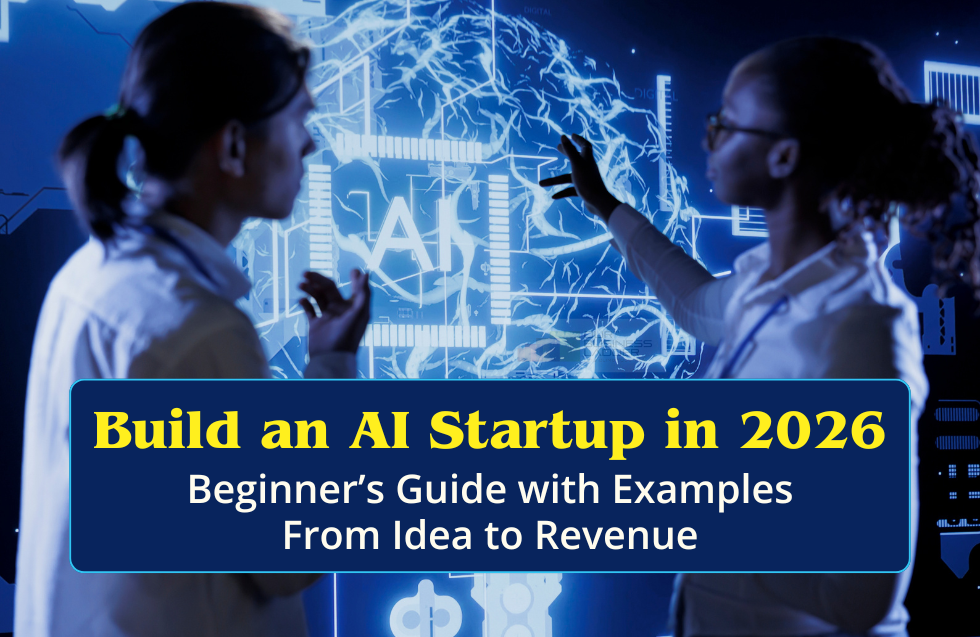
The combination of open-source models, cloud credits and the $1 trillion market demand for new solutions makes it easier than ever to start an AI business in 2026. It is now possible for almost anyone to build an AI product or even build an AI startup from scratch.
The step-by-step guide provides beginners with proven methods, real business cases and the common mistakes to avoid which will help them create revenue from their ideas.
What Is an AI Startup?
AI startups use artificial intelligence as their main technology to create scalable products which include chatbots, predictive analytics, generative tools and automation platforms. These ventures disrupt industries by automating tasks, personalizing experiences and unlocking insights at unprecedented speed. AI startups use machine learning models which developers train with extensive data sets to create products which evolve through customer interaction.
AI startup companies that operate at the highest level include Anthropic which developed Claude and xAI which created Grok models. AI startups will control the healthcare, e-commerce and climate technology industries in 2026.
Step 1: Find Winning Ideas to Build an AI Startup
The first step requires you to create AI startup concepts that will achieve success in their business efforts. Successful solutions lead to elimination of major challenges which remain unaddressed in current markets.
The 2026 trends display two main technological advancements which include agentic AI and multimodal models which combine text, image, video content and specialized vertical tools.
The list of AI startup concepts for 2026 to 2027 includes the following business ideas:
- Personalized Health Coaches: AI apps analyzing wearables for custom wellness plans.
- AI Content Orchestrators: Tools that create automatic SEO content which includes blogs, videos and social media posts.
- Supply Chain Predictors: The solution provides instant logistics improvement which decreases operational expenses by 30 percent.
- EdTech Tutors: Adaptive learning platforms which provide educational assistance that competes with human teachers.
- Climate Risk Analyzers: The system uses satellite data to forecast future floods and wildfires which insurers use for their risk assessments.
The research study needs validation through three methods which include Typeform surveys and Reddit polls from r/Entrepreneur and direct messaging to 100 potential study participants. The team needs to develop initial prototypes through free access to Hugging Face datasets.
Step 2: Choose Your AI Startup Business Model
Align your model with strengths, technical depth or sales savvy. AI startup business models break down like this:
| Model | How It Works | Revenue Potential | Example |
| SaaS Subscription | User-friendly AI tools | $10K-$100K MRR | Jasper.ai (writing AI) |
| API Licensing | Sell model access per query/call | Usage-based ($0.01-0.10) | OpenAI API |
| Enterprise Custom | Tailored solutions for corps | $50K+ contracts | UiPath (RPA automation) |
| Data Marketplace | Monetize proprietary datasets/models | Licensing fees | Scale AI (data labeling) |
| Freemium Micro-SaaS | Niche tools for creators SMBs | $5-49/month | Midjourney (image gen) |
SaaS leads for beginners—recurring revenue with low churn. Aim for $3-5K MRR in 6 months via indie hacker communities.
Step 3: Build Your Lean Team and Tech Stack
The 40% of unicorns which started with 1-2 people demonstrate that solo founders achieve success. This proves you do not need a large team to build an AI startup in 2026. The following methods serve as recruitment tools:
- Y Combinator and FounderDating provide platforms for co-founder matching.
- The Upwork/Toptal platforms enable hiring freelancers who work as ML developers at an hourly rate between $60 and $200.
- The first employees must receive equity compensation because we seek to attract dedicated employees who will work for our company.
2026 Tech Stack:
- Models: Llama 3.1, Mistral or fine-tune via Grok API.
- Frameworks: LangChain/LlamaIndex for agents; Streamlit for UIs.
- Infra: Vercel/Replit for no-code MVPs; AWS Bedrock for scaling.
- MLOps: Weights & Biases, Comet.ml.
Prototype in 2-4 weeks—leverage 100K+ free GPU hours from Colab or Kaggle.
Step 4: Develop and Price Your MVP
Value-based tiers: Free (hook), Pro ($19-99/mo), Enterprise ($500+). 60-80% margin calculations require cost estimation which includes GPU costs of approximately $1 per hour and API costs of $0.005 for every 1000 tokens used. A/B test through Stripe because Descript charges $12 per user for its transcription magic service.
MVP roadmap:
Your goal is not perfection but to build an AI solution that solves one clear problem.
- Core feature (e.g., AI video editor).
- User testing (50 betas via Product Hunt).
- Analytics (Mixpanel) + iterate.
The three platforms for demonstration purposes are HN, Twitter and TikTok.
The startup ElevenLabs developed voice AI technology to achieve $10 million in annual recurring revenue while Perplexity AI established its search operation as a unicorn business through its method of providing verified responses to users.
Step 5: Market, Acquire Customers and Scale Revenue
Viral Loops operates through its referral system which provides customers with referral credits that offer them 20 percent discounts.
The Content Engine produces content through its YouTube breakdowns and LinkedIn threads.
The company established partnerships through its association with Shopify and its development of Zapier applications.
The company spent $5000 on Meta advertisements that specifically targeted people interested in “AI tools.”
The company achieved $10000 in monthly recurring revenue when 500 customers paid $20 per month. The company calculates its customer acquisition cost through the ratio of customer lifetime value which exceeds three times the acquisition cost.
Funding Your AI Startup
Where can I raise funding to build an AI startup?
- Pre-seed funding which ranges between $50,000 and $250,000 comes from angel investors and Y Combinator which offers $500,000 in exchange for 7 percent equity.
- Seed funding which ranges between $1 million and $5 million comes from venture capital firms that include a16z and Sequoia AI funds.
- The company provides revenue-based financing through Lighter Capital while it offers grants through NSF SBIR for US territories.
- The 2026 Landscape shows that AI venture capitalists invested more than $50 billion into the industry during 2025 while investors choose to concentrate on businesses that demonstrate market growth.
- The pitch deck includes three components which describe the problem and present the MVP demonstration and show the $MRR and TAM value which exceeds $100 billion.
The five AI Unicorn Startups receive special attention in this report.
Growth hacks:
- Viral Loops: Referral credits (e.g., 20% off).
- Content Engine: YouTube breakdowns, LinkedIn threads.
- Partnerships: Shopify/Zapier apps.
- Paid: $5K Meta ads targeting “AI tools.”
- Hit $10K MRR: 500 users at $20/mo. Track CAC:LTV >1:3.
Funding Your AI Startup
- Pre-seed ($50-250K): Angels, YC ($500K for 7%).
- Seed ($1-5M): VCs like a16z, Sequoia AI funds.
- Alternatives: Revenue-based (Lighter Capital), grants (NSF SBIR for US).
- 2026 Landscape: $50B+ AI VC poured in 2025; focus on traction.
- Pitch deck: Problem, MVP demo, $MRR, TAM ($100B+).
Spotlight: 5 AI Unicorn Startups
Short intro of unicorn startups:
- Anthropic ($61B): Safe constitutional AI with Claude; $8B from Amazon. Lesson: Ethics wins big.
- xAI ($50B): Grok models for truth-seeking; Musk-backed rapid scaling.
- Mistral AI ($6B): Open-weight efficiency; €600M EU funding.
- Suno ($3B): AI music from text; $125M post-viral demos.
- Runway ($4B): Video gen tools; Hollywood adoption drove growth.
The company achieved over 1 billion dollars through its success in operating specialized markets while developing its business model through public experiments.
Common Pitfalls and Pro Tips
Pitfalls: No PMF validation API dependency ignoring regs GDPR AI Act
Tips: Recommend weekly product releases which should follow an 80 20 rule for essential features. The tips recommend using bootstrap funding as a way to achieve business growth.
FAQs
1. What is an AI startup?
A company using AIML as the foundational tech to build innovative scalable products like automation tools or predictive platforms.
2. List the AI startup companies
Leaders: OpenAI, Anthropic, xAI—pioneering LLMs and agents.
3. List the AI startup business models
SaaS, API, enterprise custom, data sales—SaaS for fastest revenue.
4. List some examples of AI startups
Anthropic (Claude), Runway (video AI), Jasper (content).
5. List some AI startup ideas 2026
Agent builders, vertical AI (health/logistics), multimodal creators.
6. How should I price my AI startup?
Price between $19–$99/month and charge 3–5× the value or savings you create.
7. Where can I raise funding for an AI startup?
YC, a16z, angels which show $5K+ MRR for best terms.
8. List the Top AI startup
Anthropic — Redefining safe and powerful artificial intelligence.
Conclusions:
In 2026, AI democratizes entrepreneurship through its free tools which lead to market growth and create successful business outcomes. Select one concept to develop into a minimum viable product which you will launch after completing it this weekend. The fastest way to build an AI startup is to start small, validate quickly and scale with user feedback. Your revenue milestone currently exists as a waiting point for your next business partner.