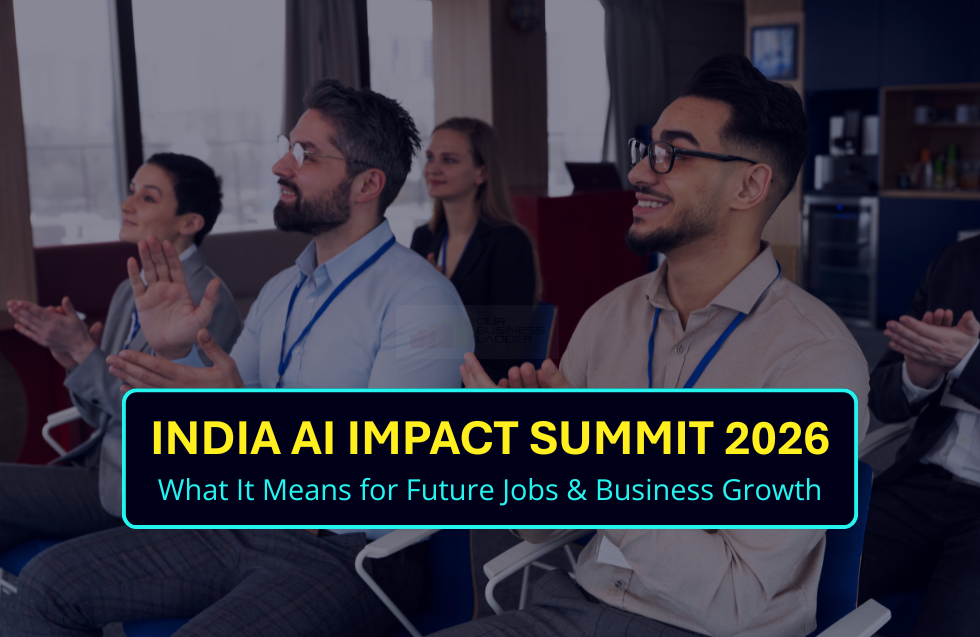
The India AI Impact Summit 2026 just ended its proceedings in New Delhi after attracting international leaders who participated in discussions about AI’s global impact at Bharat Mandapam. The India AI Mission hosted this event which showcased tangible AI advances alongside challenges like job shifts and new entrepreneurial opportunities.
India AI Impact Summit Overview
From February 16 to February 21 in 2026 more than 20 heads of state and 60 ministers and technology leaders Sundar Pichai and Sam Altman will meet at Bharat Mandapam. Prime Minister Modi started the event by delivering his speech which was followed by speeches from French President Emmanuel Macron and UN Secretary-General António Guterres.
The summit built on prior events like Bletchley Park and Paris, but as the first in the Global South, it pushed for inclusive AI under three pillars:
- People
- Planet
- Progress
The seven working groups studied economic growth together with methods to develop secure artificial intelligence systems.
The expo featured 300 exhibitors from 30 countries together with the launch of Sarvam AI’s new language models and smartglasses which Modi personally tested. India even snagged a Guinness record for 250,000 AI responsibility pledges in a day.
Key Highlights from Bharat Mandapam AI Summit
- Expo Inauguration: Prime Minister Narendra Modi inaugurated the India AI Impact Expo at Bharat Mandapam on February 16, 2026, featuring over 600 high-potential startups and pavilions from 13 countries including Australia, Japan, Russia, the UK, France, Germany and Italy.
- Day 1 Focus: The expo buzzed with AI demonstrations in health, agriculture and more; PM Modi interacted with startups, researchers and tech leaders at various stalls.
- Day 2 Highlights (Feb 17): High-level panels launched casebooks on AI applications in education, energy, health, agriculture, gender empowerment and disabilities; sovereign AI models like Inya VoiceOS (5B parameters, 15+ languages) and BharatGen (17B parameters) were unveiled.
- Research Symposium (Feb 18): Academics and researchers from India, the Global South and internationally gathered to present frontier AI work, fostering collaborations on inclusive and responsible AI under themes like human capital and safe AI.
- CEO Roundtables: CEOs held discussions with policymakers on scaling AI for economic growth, social good and resilience.
- PM Modi’s Key Message: Modi stressed that AI must be human-centric, responsible and serve human needs, urging “Design and Develop in India. Deliver to the World”; he compared AI to nuclear power, highlighting its potential for solutions with the right direction.
- Live Demonstrations: Showcased humanoid robots like booster performing tasks (picking, dancing), autonomous drones for delivery, edge computing robots and AI agents for commerce; minor technical glitches in advanced robotics demos underscored challenges in large-scale deployment.
Here’s a snapshot of job shifts discussed:
| Sector | Jobs at Risk (by 2030) | New AI Opportunities |
| Manufacturing | 60M repetitive tasks | Data annotation, ethics |
| Healthcare | Basic admin | Predictive diagnostics |
| Agriculture | Manual labor | Yield advisory, drones |
Infrastructure & Technological Impact
The infrastructure demonstration led to the most significant impact through:
- The IndiaAI Compute Portal, which will provide 20000 additional GPUs
- Microsoft’s $50 billion commitment to develop solutions for developing countries
- The BharatGen system, which enables 22 Indian languages to be used
Overall Impact
The summit (Feb 16–20) themed “Sarvajana Hitaya, Sarvajana Sukhaya” concluded with the New Delhi Declaration on AI Impact endorsed by 88 countries; it positioned India as a global AI hub with three Made-in-India AI models launched.
Key Discussion Points
Talks centered on three pillars:
- People (healthcare, education, financial inclusion)
- Planet (sustainability, climate action)
- Progress (growth, governance)
Seven “Chakras” working groups shaped outcomes:
- Human Capital: Reskilling for AI-era jobs.
- Inclusion: Equity for underserved communities.
- Safe & Trusted AI: Ethics, safety benchmarks.
- Resilience: Disaster response, efficiency.
- Science: R&D innovation gaps.
- Democratizing Resources: Compute, data access.
- Economic & Social Good: Business models in agriculture, health.
These led to 15+ deliverables, like global governance frameworks and AI Safety Institute expansions.
How It Impacts Jobs
The summit’s discussions directly reshape India’s job landscape.
According to projections from global workforce studies such as the World Economic Forum, automation could significantly impact manufacturing roles by 2030, particularly repetitive tasks in textiles and assembly operations.
(Based on global workforce projections from institutions such as the World Economic Forum and McKinsey Global Institute.)
The Human Capital and Inclusion groups showed that high-skill jobs existed because they forecasted 10 million AI ethics, prompt engineering, data annotation and model deployment jobs to emerge by 2030.
The healthcare industry will implement AI systems to enable nurses to focus entirely on patient care while farmers will receive AI-powered yield advisory services.
Quick Reskilling Checklist:
- Digital India programs (50M workers)
- Prompt engineering/data annotation
- IndiaAI Compute Portal practice
The process of reskilling will become the essential factor that determines success. The Digital India program which supports summit initiatives plans to educate 50 million workers about AI skills which will convert potential job losses into job advancements. Without this, urban youth in BPO and rural laborers face risks; with it, India leads global AI talent export.
Business Growth Transformation through Summit Results
The summit results provide substantial advantages to businesses which are based on their outcomes.
The Economic & Social Good group developed agricultural AI technology through crop monitoring drones which now enable healthcare organizations to use predictive diagnostics.
Industry analysts suggest that AI-driven efficiency improvements could contribute substantially to India’s GDP growth by 2030, especially across agriculture, healthcare and logistics sectors.
The democratization of resources benefits small and medium enterprises through affordable local computing which enables them to achieve 70% reduced AI development expenses.
This enables small businesses to develop their own inventory prediction systems and custom chatbot solutions. Major companies such as Reliance are able to adapt their products for specific Southeast Asian markets through their ability to create localized versions of their systems.
The investor market shows strong momentum which comes from the Peak XV and Yotta companies making GPU investments.
Ethical AI frameworks reduce regulatory risks while Planet pillar initiatives create new environmental markets that support climate-friendly supply chain operations.
The implementation of artificial intelligence technology will increase the success rate of startups which operate in technology hubs such as Bengaluru.
Will AI Replace Human Workers?
AI creates genuine employment threats which especially affect India because of its large workforce. Reports indicate that automation will transform 60 million manufacturing jobs between now and 2030 while the textile and entry-level IT positions will face severe impacts.
The summit reversed its original direction because of its findings. Experts report that AI increases productivity through its operational benefits which create new employment needs for AI management and data processing experts. Robots will take over basic tasks in blue-collar fields such as healthcare enabling human workers to concentrate on more difficult medical duties.
India’s response? Focus on reskilling via the summit outcomes, like workforce transition programs. Think lifelong learning to turn threats into gains. The long-term employment outcome will depend heavily on how effectively reskilling and workforce transition programs are implemented.
Business Opportunities from AI Adoption
AI is not just a disruptor; it’s a goldmine for Indian businesses. The summit showcased healthcare diagnostic solutions and agricultural yield prediction systems which startups can implement at scale.
Entrepreneurs can explore AI services through custom chatbots and predictive analytics solutions designed for e-commerce applications. The talent pool in India enables companies to develop reusable AI platforms which will transform their operations from service delivery to product development.
The government initiative known as sovereign compute enables organizations to reduce expenses for conducting model training at their own facilities. The agriculture and governance sectors provide accessible opportunities because AI applications for crop monitoring and citizen service delivery will experience rapid growth. Peak XV and Yotta’s GPU bets signal investor confidence.
Imagine Reliance or Adani scaling AI tools regionally. The “democratised AI” push means affordable access for SMEs, fueling growth in the Global South.
Future Jobs in AI-Driven India
The summit painted a balanced picture. Routine coding and data entry fade, but new roles emerge in AI ethics, model training and integration. India could lead in “AI for the next billion,” blending tech with local needs.
Expect a surge in demand for 10 million AI-related jobs by 2030, from prompt engineers to biased auditors. Sectors like IT services evolve to AI consulting, keeping India competitive.
Challenges remain, like energy demands and biases, but commitments to ethical frameworks help. Upskilling programs tied to Digital India will bridge gaps.
Strategies for Business Growth
To thrive, businesses should start small: audit operations for AI fits, like chat support or inventory forecasts. Partner with startups from the expo for quick wins.
- Invest in talent via platforms like IndiaAI.
- Focus on open-source models for cost savings.
- Track summit outcomes for grants on compute access.
- Sustainability also matters, AI for climate resilience offers green business angles. Network at future events to stay ahead.
FAQs
1. What is the India AI Impact Summit?
The India AI Impact Summit 2026 took place between February 16 and February 21 at Bharat Mandapam in New Delhi because MeitY organized the event as part of its IndiaAI Mission. The summit brought together leaders to examine how artificial intelligence affects both social systems and economic frameworks and ethical principles.
2. Where was the Bharat Mandapam AI Summit held?
The event occurred at Bharat Mandapam in New Delhi which included an exhibition displaying various health, agricultural and other fields through its different pavilions.
3. What are AI Impact Summit highlights?
The event featured several important events which included the introduction of new Indian artificial intelligence systems by Sarvam, BharatGen and the expansion of GPU systems and Microsoft’s financial backing and the achievement of a Guinness World Record for AI commitments.
4. Will AI replace human workers?
AI will take over simple work responsibilities which will impact manufacturing and IT jobs because companies need to train workers for new jobs that require higher skills while AI increases workplace efficiency.
5. What business opportunities arise from AI adoption?
AI tools create multiple business possibilities which extend across agricultural, healthcare and service sectors while the government supports both consulting services and product development through its established infrastructure.
6. How to reskill?
Build skills in AI fundamentals, ethics and deployment as India targets 10M AI-related jobs.
7. What are the next steps?
Track deliverables at impact indiaai.gov.in Download casebooks at indiaai.gov.in and start leveraging AI today.