
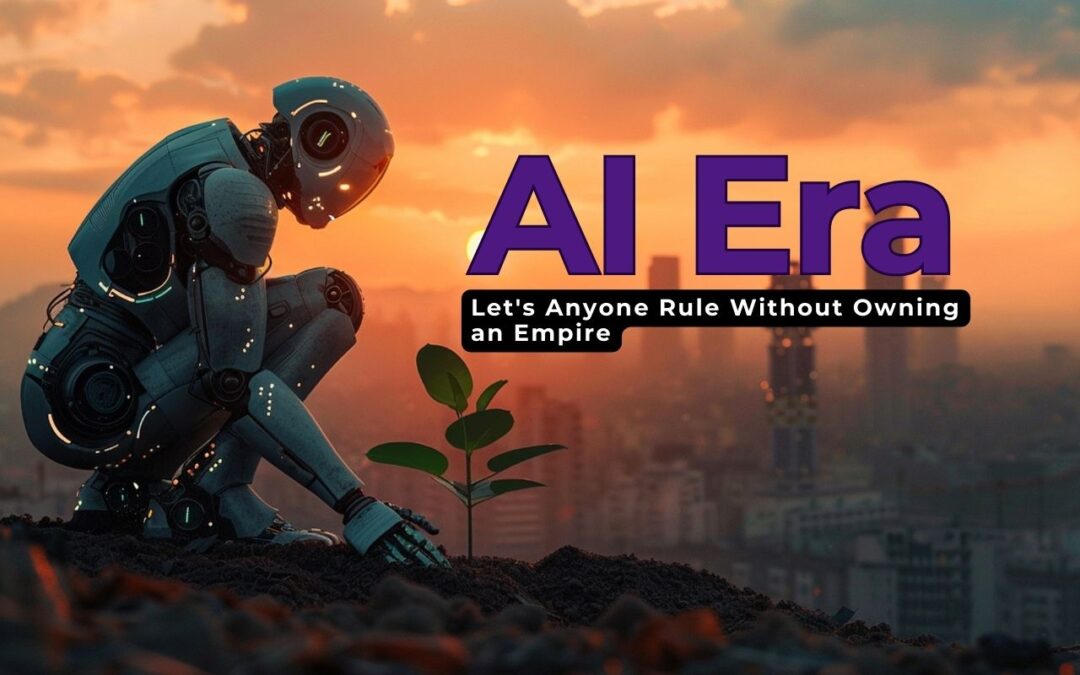
Power has always governed history, its holders, sustainers and rulers. For 1000 of years, kingdoms and empires shaped world order. From the grand empire of Rome to China’s dynasties, command was linked to armies, resources and terrain. But in the current AI Era, that equation is being redefined. Influence no longer relies on land or troops, it lies with access to digital tools, simulations and stories that are able to traverse the globe in seconds.
We are seeing the emergence of “kings without kingdoms” small players and individuals able to wield disproportionate influence owing to AI technologies.
Empires Then vs. Influence Now
- Historical empires were founded on expansion, conquest and control of resources.
- Dynasties tended to revolve around family lineage, dynastic rule and defense of territory.
- A dynasty or emperor’s power was determined in land, wealth and war.
AI Era Comparison
- The strongest assets are data, algorithms and attention.
- Rather than armies- people use AI weapons
- Rather than palaces- they reign from laptops
- Rather than land- they govern through networks
2. Digital Civilizations and Simulated Societies
One of the most intriguing trends in the last year is the emergence of AI simulations that simulate human-like societies.
- Project Sid (2024): Scientists developed thousands of AI agents in virtual worlds such as Minecraft. The agents developed their own distinct cultures, norms and even religious practices exhibiting “civilizational” behavior without a territory.
- AgentSociety (2025): An enormous 10,000-agent simulation in which AI agents behaved within realistic social and economic settings. Examples of polarization, disaster planning and financial stress testing were simulated to analyze systemic behavior.
These initiatives demonstrate how governance, conflict and culture can take place in purely virtual environments. Leadership no longer needs land in the AI Era, it needs the power to shape complex and interlinked systems.
3. Governance for a Borderless Age
If power is moving to virtual realms, how do we make it accountable? Just as kingdoms had laws and empires had constitutions, AI societies will require systems of governance:
- HAIG (Human-AI Governance): HAIG is an adaptive framework for jointly allocating decision-making authority, autonomy and responsibility between human and AI actors. It evolves with changes in trust and utility over time.
- UCF (Unified Control Framework): A 42-control compliance model that assists organizations in aligning AI with ethical and legal frameworks, including the Colorado AI Act.
These frameworks are basically the constitutions of the AI Era making sure that power, while democratized, is still checked and organized.
4. AI as the Great Equalizer
The most profound and diverse change felt by us in the Age of AI is the democratization of power. Previously restricted to corporations or governments, equipment is now available to anyone.
- Content Creation: With AI tools like ChatGPT, Midjourney and Runway ML, anyone can make pro-level text, images and videos without huge budgets.
- Marketing & Analytics: AI helps startups act big, offering smart ads, SEO boosts and automated social media to rival Fortune of over 500 brands.
- Customer Service: AI Chatbots and in-gaming assistants provide a 24/7 customer service hostile, providing small businesses with enterprise-grade service level quality.
The democratization allows a solo business to behave like a mini-empire speaking to thousands through the force of AI.
5. Efficiency and Productivity at Scale
Another characteristic of the AI Era is extreme efficiency:
- Automation: Repetitive activities like data entry, scheduling or document reading are done via AI, so humans can shift to higher-order creativity and strategy.
- Smart Decisions: With massive datasets, AI provides insights into finance, customer behavior and market movement. Humans now make decisions that previously needed whole analytical departments.
Small groups can attain the productivity of whole kingdoms.
6. Distributed Intelligence and Collective Power
Empires were dependent on centralized command but AIs are more adept at decentralized cooperation.
- Multi-agent systems allow multiple AI systems to work together, solving complex problems linked to climate simulation or logistics optimization.
- Shared intelligence models link individuals to a shared pool of knowledge and insights.
- Global collaboration tools erase borders, allowing people to co-create projects across time zones with ease.
This is power without territory: distributed, networked and borderless.
7. Personalized Growth and Influence
Arguably the most empowering feature of the AI Era is personalization:
- Education: AI systems design tailor-made learning trajectories, detecting skill deficiencies and suggesting courses or tutorials for professional development.
- Marketing: Personalized efforts enable individuals to create close-knit groups and loyal followers in competition with the reach of old-fashioned media empires.
While empires once operated on mass, with their jurisdiction being abstract laws at work, AI connects people and allows them to develop their own potential together.
8. The Power of Storytelling in the AI Era
Historian Yuval Noah Harari posits that civilizations are constructed through shared narratives about nations, money and laws. AI enhances this power by making it possible to create and disseminate tales on a scale. One influencer, activist or entrepreneur can fashion collective beliefs across millions through AI-powered storytelling. In the AI Era, whoever owns the story owns the kingdom even if it has no borders.
9. Platforms as the New Kingdoms
Social platforms are the war zones of influence. Reddit, for instance, survives on genuine human conversation but is challenged by AI-generated posts. To preserve trust, it’s developing AI-powered moderation systems. This friction exposes the contradiction of the AI Era while AI provides accessibility to voices and can also operate to separate the voice from itself. Governing in virtual kingdoms today no longer requires only influence but credibility and governance.
10. Rethinking Leadership
To rule in the past meant possessing land, subjects and armies. To rule in the AI Era means having:
- Commanding attention.
- Harnessing AI to scale creativity, efficiency and reach.
- Establishing trust and stories that evoke loyalty.
- Transcending governance to balance human and machine power.
In essence, today kings no longer need kingdoms they need AI.
Conclusions:
The AI Age has redefined what ruling means. Armies and empires ruled before but now networks influence and digital power define authority. From customized development to simulations by AI, human beings are equipped to exercise unprecedented control without ever possessing a kingdom.
FAQs
1. What is the AI Era?
The AI Age is our present era of technology where artificial intelligence fuels change in society, economy and culture making influence possible without historical forms of power.
2. How are digital civilizations represented by AI simulations?
Experiments such as Project Sid and AgentSociety employ AI agents to create rules, culture and economies demonstrating that government and society can be digitally realized.
3. Why is governance key in AI societies?
Frameworks like HAIG and UCF help ensure AI systems remain ethical, accountable to users who adopt it and aligned with human values.
4. How does AI democratize power?
By reducing barriers to content creation, marketing and customer service. AI allows small players to behave with the force of large organizations.
5. What role does personalization play?
AI customizes learning, marketing and content distribution enabling individuals to grow and engage more effectively with audiences.
6. Can platforms be digital kingdoms?
Yes. Sites such as YouTube or Reddit function as spheres of influence, where narrative power, credibility and governance trump territorial domination.
7. Will the AI Era supersede conventional power?
Not all the way but it introduces a new dimension where land no longer is the measure of leadership but influence instead.