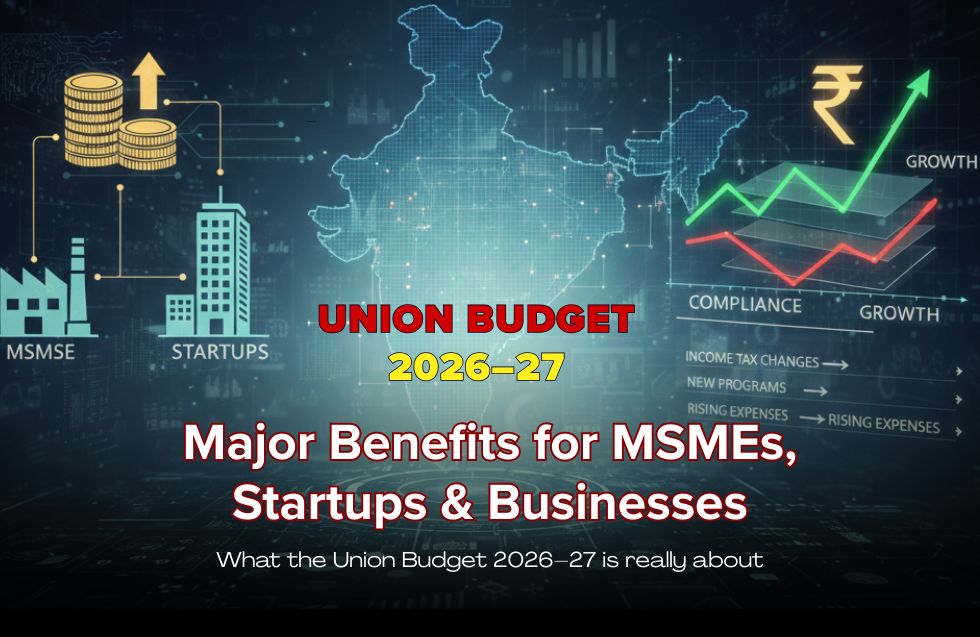
The Union Budget 2026–27, presented by Finance Minister Nirmala Sitharaman, is being seen as one of the most entrepreneur‑friendly budgets in recent years. The government provides specialized financial aid, streamlined credit facilities, compliance requirements and sector-based incentives to support MSMEs, startups and small enterprises. The budget presents practical solutions which will help Indian business owners, company founders and independent workers to expand their operations.
The Union Budget 2026–27 provides a detailed explanation which shows how MSMEs and startups and businesses will be affected by income tax changes, new programs and rising daily expenses.
1. What the Union Budget 2026–27 is really about
The budget maintains India’s growth trajectory through its unprecedented capital expenditure of ₹12.2 lakh crore which supports infrastructure development, logistics networks and public works initiatives. Entrepreneurs will benefit from improved cash flow, simplified borrowing processes and stable demand through the existing financial support systems, tax modifications and spending initiatives.
The fundamental business themes are:
- MSMEs and startups will benefit from improved access to affordable funding sources which include both credit and equity investment.
- Small taxpayers will experience easier compliance requirements together with reduced penalty measures.
- Manufacturing, electronics, biopharma, textiles and creative industries will receive sectorspecific manufacturing boosts.
The price of essential goods and services which customers and businesses use has experienced fluctuations that include both price reductions and price increases.
2. MSMEs
The 2026–27 budget contains specific budgetary policies which will enhance the financial stability and operational capacity of MSMEs because they serve as the fundamental economic base of India.
New MSME Growth and Resilience Fund
The government has introduced a dedicated MSME Growth and Resilience Fund which will provide ₹10,000 crore in equity-based assistance to micro, small and medium enterprises. The fund provides financial assistance to businesses which want to develop their operations through technological upgrades, international market expansion, protection against global economic and supply chain disruptions.
For many small manufacturers and service providers this type of patient capital funding creates a vital opportunity which enables them to either develop their business operations or explore new market prospects.
MSMEs face their most significant challenge because large companies, government agencies and public sector enterprises delay their payments. The budget now mandates that all Central Public Sector Enterprises (CPSEs) must use TReDS (Trade Receivables Discounting System) for all financial transactions.
This means:
- MSME suppliers can discount their invoices early and get cash faster.
- Reduced risk of payment delays or defaults from big clients.
- Better working‑capital management for small units.
The government is expanding existing credit guarantee programs such as CGTMSE to boost bank lending rates for MSMEs which have limited collateral security.
The Self-Reliant India Fund receives a 2000 crore top-up which will serve as risk capital funding for high-potential SMEs and startups. This financial solution becomes essential for businesses that surpass micro-finance limits yet remain too small and new to secure substantial private equity funding.
3. What the budget means for startups
The 2026-27 budget maintains fiscal discipline while providing necessary support to India’s rapidly expanding startup ecosystem which has developed since the past 10 years. The company focuses its activities on deep technology development and manufacturing-related innovative activities which will create permanent employment opportunities.
Fund of Funds for Startups (FFS) boost
The Fund of Funds for Startups (FFS) receives a fresh ₹10,000 crore allocation. The allocated funds will be sent through SEBI-registered venture capital and private equity funds which will use this capital to make investments in startups at both early and growth stages.
Founders will experience these benefits
They gain better access to permanent institutional funding which replaces their need for angel network assistance.
Companies in the biotech hardware and industrial technology sectors now have additional funding sources for their Series A and later-stage funding requirements.
The Biopharma Shakti program plans to distribute 10000 crores for domestic biopharma manufacturing research and development and production facility support. Startups in this sector can showcase their work through:
- APIs and formulations
- Vaccine development
- Medical devices and diagnostics
The budget provides support for electronics, semiconductors, textiles and AVGC (Animation Visual Effects Gaming Comics) industry development through special programs and infrastructure funding.
Tax and compliance relief for startups
The government has also tried to reduce tax‑related uncertainty for startups:
- Angel tax issues have been largely resolved, giving clarity to early‑stage investors.
- ESOP tax reforms allow employees and founders to defer some tax liabilities, making stock options more attractive as a compensation tool.
The modifications create safer conditions for startups to operate and expand their businesses throughout India.
4. Income tax changes and what they mean for businesses
The public has focused its dialogue about the Union Budget 2026–27 on two main topics which are income tax slabs and personal tax relief. The indirect effects of this situation impact businesses in a significant way.
The income tax slabs which currently exist will remain unchanged
The tax structure for the new tax system maintains existing income tax brackets without any alterations for fiscal year 2026-2027. The existing slab structure remains in place which means:
- Slab changes do not affect the take-home pay of most salaried workers and professionals since their income will stay the same.
- Slab changes will not create an instant boost to disposable income for businesses which depend on consumer spending through retail services and lifestyle operations.
All other taxes including customs duties and excise taxes change product prices which in turn affects consumer demand.
Simplified compliance and softer penalties
The budget has introduced new deadlines which allow taxpayers to submit their updated or corrected income tax returns while changing some penalties into fees. Small businesses and professionals will experience these advantages from the new system:
- The system reduces pressure on people who fail to meet their upcoming deadlines.
- The system decreases the possibility of receiving severe penalties which would result from making minor mistakes and technical inaccuracies.
- First-time entrepreneurs and sole business owners will experience less compliance stress because of these minor adjustments.
5. Sector‑wise opportunities from Union Budget 2026–27
The budget provides general financial assistance which helps the government identify main areas for job creation, export activities and research development.
Manufacturing electronics and semiconductors
The India Semiconductor Mission 2.0 develops a complete semiconductor ecosystem which covers all aspects from design work to chip production. The program enables startups and MSMEs to access new business opportunities through these areas:
AVGC, creative industries and women‑led enterprises
The government is investing in AVGC (Animation, Visual Effects, Gaming, Comics) and related creative‑tech institutes. This is good news for:
- Animation studios
- Gaming startups
- Content‑creation platforms
At the same time, rural SHE Marts and women‑led enterprise schemes are being promoted to help women entrepreneurs access markets, finance and training.
6. What gets cheaper and what gets costlier after Budget 2026
The budget shows its most important effects through changes in prices for basic goods which people use in their everyday lives. The 2026–27 budget changes multiple products through its modifications to customs excise and GST duties.
Items that will likely become cheaper
- The price of Indian-made smartphones and TVs will decrease because manufacturers will pay less tax on their locally produced products.
- Electric vehicles (EVs): The existing policies and tax incentives continue to support EVs which makes them more desirable to potential customers.
- Cancer drugs and certain medical devices: The reduction of tariffs on essential medications and medical devices will lead to lower healthcare expenses which patients need to pay.
- Home loan tax deduction: It does not directly reduce home loan costs yet helps buyers by making their home purchase expenses more affordable.
Businesses can save money through lower costs of electronic products and medical equipment which benefits their operations and production processes in clinics, IT companies and small manufacturing businesses.
Items that may become costlier
- Imported luxury watches and apparel: The price of high-end imported fashion products will increase because the government raised import duties on these items.
- Foreign-built cars (CBUs): The cost of importing completely built units from overseas will increase because customs duties have increased.
- Premium cosmetics and perfumes: The retail price of high-end beauty products will increase because the government raised import duties on these goods.
- Gold and silver jewellery: The price of jewelry will increase because the government raised import duties on precious metal imports.
- Tobacco and cigarettes: The tobacco product excise tax increase will result in higher retail prices which will likely decrease product demand.
Imported luxury goods and tobacco businesses will experience reduced sales volume yet their profit margins per product will increase while local producers in the same market segment will gain from this situation.
7. FAQs: Union Budget 2026–27 for MSMEs, Startups & Businesses
1. What are the key highlights of Union Budget 2026–27 for MSMEs?
The budget establishes a new fund the MSME Growth and Resilience Fund which receives funding of ₹10000 crores and the budget makes the TReDS system compulsory for all CPSE financial transactions while the budget enhances credit guarantee programs and provides dedicated assistance to the textiles, biopharma and electronics sectors. These measures aim to improve liquidity, payment security and long‑term growth for small and medium enterprises.
2. How does the budget support startups in India?
Startups receive advantages through the establishment of a ₹10000 crore Fund of Funds for Startups and the creation of a ₹10000 crore Biopharma Shakti program while the budget establishes better tax regulations for angel investments and ESOPs. The focus is on deep‑tech, manufacturing‑linked innovation and job‑creating ventures, not just consumer‑facing apps.
3. Are there any changes to income tax slabs in Budget 2026?
The new income tax system for FY 2026–27 maintains existing tax slab structures without implementing substantial modifications to income tax brackets. The existing slab structure remains in place, so there is no direct change in tax rates for most salaried individuals and professionals.
4. Which sectors will benefit the most from Union Budget 2026–27?
The budget provides particular policy assistance, infrastructure development and financial support to manufacturing, electronics, semiconductor, biopharma, textile, AVGC and women-led business sectors.
5. What everyday items will get cheaper or costlier after Budget 2026?
The following products will become cheaper:
- Indian-made smartphones and TVs
- Electric vehicles
- Specific cancer treatment drugs and medical equipment
- Home-loan interest which will reduce through tax relief.
The following products will become more expensive:
- Imported luxury watches and apparel
- Foreign-built cars, premium cosmetics and perfumes
- Gold, silver jewelry and tobacco products.
The Union Budget 2026–27 presents itself as a practical budget which supports economic growth throughout its entirety.
Conclusions:
The Union Budget 2026–27 doesn’t dazzle with big announcements, but for MSMEs, startups and small businesses, it quietly hands them the tools to grow. The budget provides financial institutions with simplified funding procedures, reduced compliance demands and dedicated assistance for essential business segments. The ones who move first using these levers smartly won’t just survive the next few years, they will become the ones who will shape the future.