Growth is often celebrated as the ultimate signature of business success. New clients come in, revenue goes up, teams grow, opportunities are infinite. At the same time, scaling silently introduces complexities that could affect even the most efficient of operations. What once remained at the back of mind, that is, the physical resources, casts a width across departments, and flows into smaller investments, thereby weighted with higher decisions. And this is where strategic resource planning moves from the background to striking the industry itself.
Growth Changes the Nature of Risk
When a startup is scaling, the risks are increasingly becoming interconnected. Assets of traditional material sources cannot be considered in isolation; they are associated with other sources of valuation, such as tangible intellectual assets, cash and operating equity, and potential external capital injections. In order for the company to become a success, serene dedication is important, and innovation is an essential requirement. Having the motivation that has to gain meaning as time progresses, however hectic workdays can get, is thus a rare bliss.
Increased scaling increases exposure to market movements, regulation, as well as leadership transitions, one of the tools to absorb some of these difficulties is strategic asset planning. It is aimed at promoting asset allocation essential to long-term planning rather than for immediate gains. When what was instinct-driven is now more structured, it provides coherence in a time when changes happen precipitously.
Assets Are More Than What Appears on the Balance Sheet
As businesses grow, their assets form beyond merely financial holdings. Reputation of the brand, systems that are exclusive to the trade, client data, and strategic relations mostly outweigh the physical properties. Careless treatment of these assets can crimp, to a considerable extent, the ability of the company to expand further or otherwise expose it to concealed risks.
Thoughtful asset planning encourages leaders to ask deeper questions. Which assets truly drive value? Which ones require protection or reinvestment? Which no longer serves the business direction? Addressing these questions early prevents stagnation and ensures resources continue to support expansion rather than slow it down.
This perspective also seamlessly extends to succession planning for business owners in which asset transparency has an important role that facilitates continuity. It takes into consideration where the value lies within the business, this makes transitions easier whilst safeguarding what has already been built over the years.
Scaling Brings Personal and Business Finances Closer Together
As companies grow, the line between the business asset and personal wealth is blurred, especially for founders and long-term owners. Decisions regarding reinvestment, diversification, and preservation could have corresponding effects on both spheres, as well. Strategic asset planning provides a framework to manage this overlap responsibly.
Some entrepreneurs believe that an active position should be taken as regards investment in other unique assets apart from the normal markets. Allusions to tools covering Gold Coast bullion are also made where issues of insurance against risks and the call for stability incomes come in especially when the economy is experiencing turbulence. Even if they are not at the core of operation, such analyses are based on the realization that the prosperity in a business coincides with one’s own well-being.
Planning Creates Confidence During Uncertainty
Markets develop and industries change, so unforeseen disturbances are liable to happen. Businesses without a thought-out asset strategy are quick to adopt a reactive stance in times of uncertainty. Those who have devised ways and whose vision allows for such insights respond as a matter of course with certainty. They simply know what they own and why, how it was integrated into the big picture.
Strategic asset planning does not provide immunity to risk but does change the methods of managing it, replacing reactive decisions with deliberate ones that help the leader maintain focus during times of pressure. In due course, the event of adversity becomes indifferent, while aiding in life’s adaptability, existence, and sustainable growth.
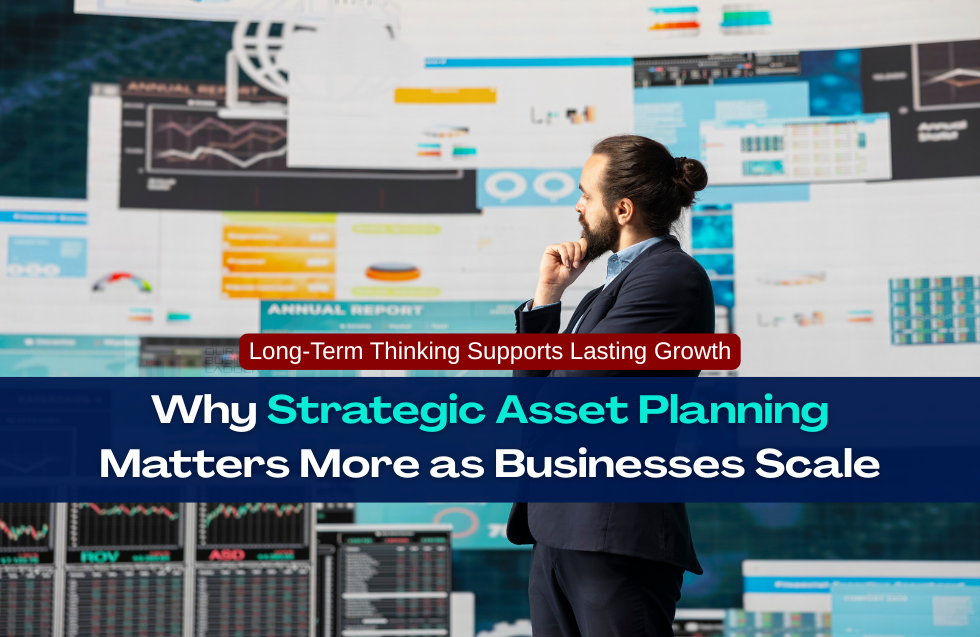
Long-Term Thinking Supports Lasting Growth
Scaling is not just about becoming bigger. It is about becoming stronger, more stable, and better prepared for what lies ahead. Strategic asset planning encourages long-term thinking at every stage of growth, ensuring that expansion does not come at the cost of control or clarity.
When assets are aligned with purpose, businesses are better positioned to evolve, transition, and endure. Growth then becomes more than a phase. It becomes a foundation for lasting success.