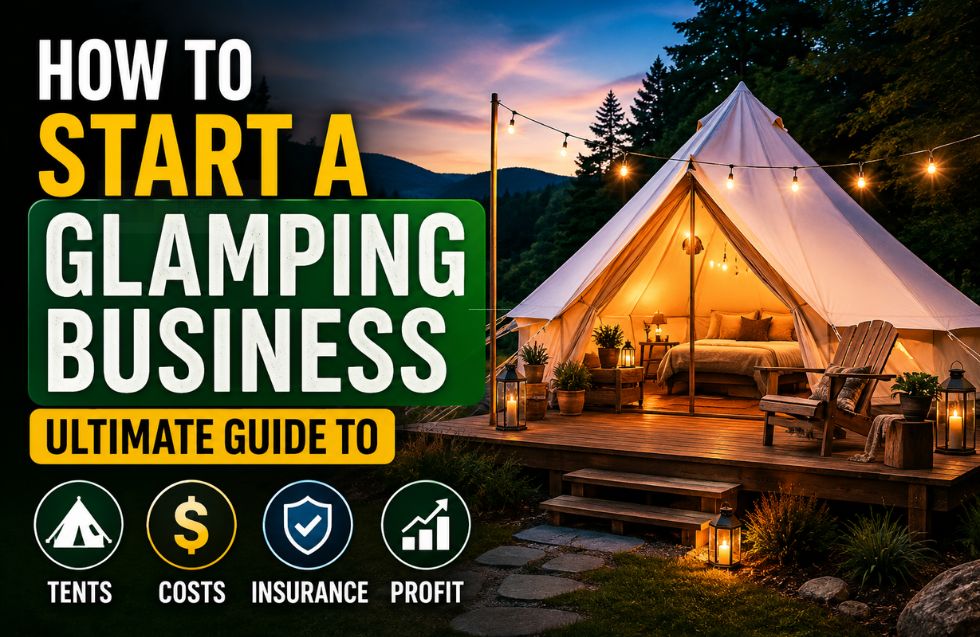
Glamping business is becoming a favorite choice among the investors and entrepreneurs who are looking for a lucrative business opportunity in the outdoor hospitality sector. Market data vividly reflects this increase. Just the U.S. glamping market is projected to bring in almost $1 billion in revenue and worldwide forecasts are pointing to the glamping industry to be worth over $5.4 billion by 2028, with even the most conservative estimates at around $4 billion by 2027.
No matter which forecast turns out to be the closest, one thing is clear: the glamping business is growing at a very fast pace. Entrepreneurs who want to benefit from this increment have to draw up a thorough business plan and have the necessary operational systems ready from the very beginning.
The main reason for this upsurge is the travelers who want to have a unique stay to which a glamping tent, glamping pod, or bell tent could be the answer, but at the same time, they want to keep the comfort and convenience. Camping in the wild has become something that the guests are not satisfied with anymore. What they want are luxuries, privacy and nature together.
Starting a business in the field of glamping can be a clever and scalable small-business opportunity in the vacation rental industry area as a substitute for the conventional rental homes.
What is glamping?
Glamping combines glamorous lodgings with traditional camping. A glamping facility features the luxury of outdoor stays which typically include a cozy bed, electricity, heating, nice décor and in some cases a private bathroom.
Currently, the glamping industry has been recognized as a separate category within the vacation rental market, it used to be considered a very small sector only. In essence, it presents a hotel-like experience albeit the natural setting.
There are many people who think that the only glamping option is tents but in fact, the glamping market has a wide variety of offerings. Some of the common accommodation types are:
Yurts
Among all, yurts are mostly chosen. Structurally, they are circular buildings having wooden skeletons and fabric as walls. Due to their size, it is very simple to add an amenity like a heater or an air-conditioning unit.
Tipis and Tents
An original tipi or a safari-style glamping tent could catch the eye and be a cheap option, but the downside is a small interior.
Caravans
Caravans are movable units that offer more space and better protection, thus it is quite easy to put luxury features in them.
Treehouses
Treehouses are eco-friendly, deeply involving the guest in nature and thus, very attractive to the ones seeking a unique stay in the wild.
Tiny Houses
Tiny houses promote green living and minimalism thus are very attractive for the ecologically conscious travelers.
Train Carriages
Old train carriages can be turned into great accommodations, although they need a lot of remodeling.
Bubble Domes
Clear bubble domes are great for viewing stars and landscapes, thus giving an unforgettable experience.
Are glamping businesses profitable?
The answer is yes. A glamping business can be very profitable if planned properly.
Glamping Business Startup Cost
The initial capital for glamping business could be as little as $3,000–$4,000, however, a luxury tent or pod unit can be over $10,000. In either case, land purchase or rental will add to the total cost.
The regular expenses will mostly be:
- Local taxes on the property
- Repair & maintenance
- Water and electricity
- Furnishing and toiletries
The glamping business insurance for operations
How much do glamping businesses make?
In the first year, the turnover might be as low as $40k and as high as $250k with the net income going from $32k to $200k on an annual basis. Since tents and pods are one-off purchases, margins are usually better after the first year.
Why run a glamping business?
- A comparatively lower cost of starting a business than that of a holiday home
- A higher profit margin
- An eco-friendly image
- The demand coming from the nature-loving travelers
- Greater freedom from the authorities with respect to non-permanent units
The above factors make luxury glamping greatly appealing to the modern travelers who are willing to pay more for experiences.
How to Set Up a Glamping Business Successfully
1. Conduct Market Research
Identify your business model (LLC, sole proprietorship, franchise) and pick a place according to the factors like demand, regulations, accessibility and climate.
2. Develop a Glamping Business Plan
The glamping business plan that you prepare should have the following elements:
- Summary of the main points
- Business goals
- Target market
- Financial outlook
- Operations & marketing plan
3. Get the Money in Place
Once the money is ready from your wallet, loans, or investors, then go ahead and register your business, as well as open banking and tax accounts.
4. Look for a Site and Permissions
This step is usually associated with questions like: Is it necessary to have planning permission for glamping pods? A lot of places allow it-giving the go-ahead for permanent buildings. There might be fewer permits required for temporary tents, but the local rules differ.
5. Select or Build Your Units
In case a glamping pod construction idea ever came to your mind, you can buy either ready-made pods or a custom-made one with features such as insulation, plumbing and electricity.
6. Facilities and Amenities
Will the facilities like showers, toilets, heating and lighting be provided for the guests? Are they anxious about their waste will be handled?
7. Decor and Comfort
The idea here is to concentrate on the basic ones first and then bring in the luxury ones such as fairy lights, hammocks, fire pits and outdoor dining.
8. Marketing and Bookings
Imagine if you camp-drop your glamping on OTAs like Airbnb and Glamping Hub, having a direct-booking website of your own and being active on social media.
9. Guest Experience
Your guests will most probably be very satisfied if you give them good communication, welcome packs, local guides and prompt response to their needs. In these conditions, positive reviews and repeat bookings will be a natural outcome.
FAQs
1. What is a glamping business?
Glamping business is a luxury outdoor accommodation business which by definition has the best of both worlds i.e. nature and modern comforts like beds, electricity and heating.
2. How do you start a glamping business?
Glamping business startup is removed outside the box with a unique market research, a business plan, a fund and an insurance policy acquisition, the setting up of a facility for lodging and promoting your place.
3. What is the glamping business startup cost?
Setting up a glamping venture may require only a few thousand dollars if you decide to use tents, while the cost may be more than fifty thousand for pods and the necessary infrastructure.
4. Are you required to have planning permission for glamping pods?
As a general rule, a fixed permanent glamping pod installation will require planning permission while a tent may not be subject to planning permission.
5. What are the steps to make a glamping pod?
Building a glamping pod involves making a decision if it is a ready-made or a specially made unit with the features like insulation, plumbing and the electrical system.
6. Is insurance required for a glamping business?
Yes. A glamping business insurance normally comprises the coverage of public liability, property insurance and employer liability if there are employees in the business.
7. How do you run a glamping business profitably?
To keep a glamping business profitable you should not lose sight of the customer experience, automate where possible, do the upkeep and marketing regularly.
Conclusion
Are you seeking a business that is flexible, scalable and experience-driven? Then, a glamping business would be a great choice right now. Due to the increasing demand, reasonable startup costs and high-profit potential, glamping is one of the most attractive opportunities in the vacation rental industry today.